P&ID in pharmaceutical industry is one of the most important engineering documents used during the design, construction, operation, and maintenance of pharmaceutical manufacturing facilities. A Piping and Instrumentation Diagram (P&ID) provides a detailed graphical representation of process equipment, piping systems, instruments, valves, control loops, and process flow within a pharmaceutical plant.
In modern pharmaceutical manufacturing, maintaining product quality, process consistency, and regulatory compliance requires accurate engineering documentation. This is where P&ID in pharmaceutical industry plays a crucial role. Engineers, operators, maintenance teams, validation professionals, and regulatory inspectors rely on P&IDs to understand how a process operates and how different systems interact with each other.
Whether it is a purified water system, clean steam generation unit, HVAC system, API manufacturing plant, or formulation facility, a properly designed P&ID serves as a roadmap for safe and efficient operation.
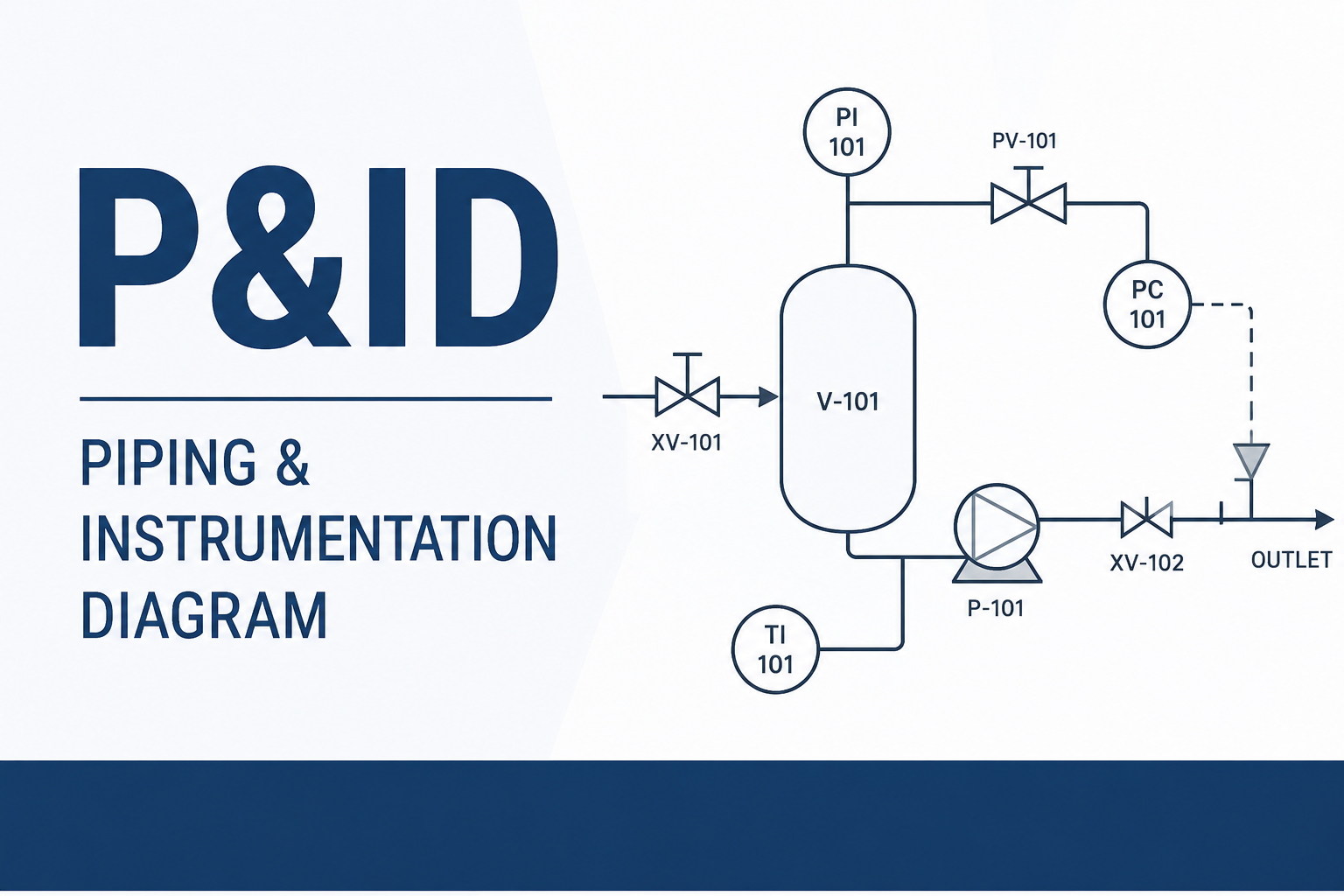
What is P&ID?
P&ID stands for Piping and Instrumentation Diagram.
It is a detailed engineering drawing that illustrates:
- Process equipment
- Pipelines
- Valves
- Instruments
- Control systems
- Utility connections
- Process flow directions
Unlike a simple process flow diagram, a P&ID in pharmaceutical industry contains detailed information necessary for plant operation, maintenance, troubleshooting, qualification, and validation activities.
Full Form of P&ID
P&ID = Piping and Instrumentation Diagram
The term combines two important elements:
Piping
Represents the network of pipes that transport liquids, gases, steam, and utilities throughout the pharmaceutical facility.
Instrumentation
Represents measuring and controlling devices used to monitor and regulate process parameters.
Examples include:
- Pressure transmitters
- Temperature sensors
- Flow meters
- Level indicators
- Control valves
Why is P&ID Important in Pharmaceutical Industry?
P&ID in pharmaceutical industry is a critical engineering document because pharmaceutical manufacturing processes are highly regulated and require precise control of equipment, utilities, process parameters, and product flow. A well-designed P&ID helps ensure that manufacturing operations are safe, efficient, compliant, and capable of consistently producing high-quality pharmaceutical products.
The importance of P&ID extends beyond engineering design. It supports production, validation, maintenance, quality assurance, regulatory compliance, and troubleshooting activities throughout the lifecycle of a pharmaceutical facility.
1. Process Understanding
One of the primary reasons P&ID in pharmaceutical industry is important is that it provides a clear understanding of the manufacturing process. Pharmaceutical plants contain numerous interconnected systems, including reactors, storage tanks, pumps, filters, heat exchangers, purified water systems, and clean steam generators.
A P&ID visually represents how these components are connected and how materials move through the process. Engineers and operators can quickly understand the sequence of operations, utility connections, process flow paths, and control mechanisms. This understanding is essential for efficient plant operation and effective decision-making.
For new employees and trainees, P&IDs serve as valuable learning tools that help them understand complex pharmaceutical processes more quickly.
2. Regulatory Compliance
The pharmaceutical industry operates under strict regulations established by agencies such as the US FDA, WHO, EMA, MHRA, and CDSCO. These regulatory authorities require pharmaceutical companies to maintain detailed documentation of manufacturing systems and process controls.
P&ID in pharmaceutical industry provides documented evidence of system design, equipment configuration, and process control strategies. During regulatory inspections and audits, inspectors often review P&IDs to verify that critical systems are properly designed and controlled.
Accurate and updated P&IDs demonstrate that a company maintains proper engineering documentation and follows Good Manufacturing Practice (GMP) requirements. This helps organizations achieve regulatory compliance and avoid inspection observations.
3. Validation and Qualification Support
Validation is a fundamental requirement in pharmaceutical manufacturing. Activities such as Design Qualification (DQ), Installation Qualification (IQ), Operational Qualification (OQ), and Performance Qualification (PQ) rely heavily on engineering documentation.
P&ID in pharmaceutical industry serves as an important reference document during qualification and validation projects. Validation teams use P&IDs to:
- Verify equipment installation
- Confirm piping connections
- Identify critical instruments
- Review process control systems
- Establish testing protocols
- Document qualification activities
For example, during purified water system validation, engineers use P&IDs to identify sampling points, pumps, storage tanks, UV systems, and distribution loops. Without accurate P&IDs, validation activities become more difficult, time-consuming, and prone to errors.
4. Maintenance Planning and Troubleshooting
Maintenance departments rely extensively on P&IDs for preventive maintenance, corrective maintenance, and troubleshooting activities.
A pharmaceutical facility may contain hundreds of valves, pumps, sensors, pipelines, and process instruments. Locating specific equipment without proper documentation can be challenging and time-consuming.
P&IDs help maintenance personnel:
- Identify equipment locations
- Trace process lines
- Locate isolation valves
- Understand utility connections
- Plan maintenance activities
- Diagnose system failures
When equipment malfunctions occur, technicians can use P&IDs to quickly trace the affected system and identify possible causes. This reduces downtime and improves overall plant efficiency.
5. Safety Improvement
Safety is a top priority in pharmaceutical manufacturing. Many pharmaceutical processes involve high temperatures, pressure systems, chemicals, solvents, steam, compressed air, and other potentially hazardous operations.
P&ID in pharmaceutical industry helps improve safety by clearly identifying:
- Safety valves
- Relief valves
- Emergency shutdown systems
- Pressure monitoring devices
- Critical alarms
- Interlock systems
Engineers use P&IDs during safety reviews, HAZOP studies, and risk assessments to identify potential hazards and implement appropriate control measures.
A properly designed P&ID helps ensure that critical safety systems are installed and functioning correctly, reducing the risk of accidents, equipment damage, and product contamination.
6. Change Control Management
Pharmaceutical facilities frequently undergo modifications, upgrades, and process improvements. Any change to equipment, piping, instrumentation, or utilities must be properly documented through a formal change control process.
Updated P&IDs ensure that all modifications are accurately reflected in engineering records. This helps maintain compliance and prevents confusion among operators, engineers, and maintenance personnel.
Accurate change management supported by updated P&IDs reduces operational risks and ensures continued process reliability.
7. Better Communication Between Departments
P&IDs provide a common technical language that can be understood by multiple departments within a pharmaceutical organization.
Departments that frequently use P&IDs include:
- Engineering
- Production
- Validation
- Maintenance
- Quality Assurance
- Quality Control
- Regulatory Affairs
Because everyone refers to the same engineering document, communication becomes more effective and misunderstandings are minimized. This improves collaboration and supports smooth manufacturing operations.
8. Training and Knowledge Transfer
P&IDs are valuable training resources for new engineers, operators, and maintenance technicians. They provide a detailed overview of system design, process flow, equipment functions, and control strategies.
Organizations often use P&IDs during training programs to help employees understand:
- Process operations
- Utility systems
- Equipment functionality
- Control philosophy
- Safety features
This knowledge transfer helps build technical competency and improves workforce performance.
9. Support for Future Expansion
As pharmaceutical facilities grow, existing systems may require expansion or modification. P&IDs provide the engineering foundation needed for future projects.
Engineers use existing P&IDs to evaluate system capacity, identify connection points, and design new process additions. This helps ensure that expansions are completed efficiently while maintaining regulatory compliance and operational reliability.
10. Improved Operational Efficiency
Ultimately, P&ID in pharmaceutical industry contributes to overall operational excellence. By providing detailed information about process systems, P&IDs help organizations:
- Reduce downtime
- Improve troubleshooting speed
- Enhance process control
- Increase equipment reliability
- Maintain product quality
- Support regulatory compliance
These benefits lead to improved manufacturing efficiency and better business performance.
Key Takeaway
P&ID in pharmaceutical industry is much more than an engineering drawing. It is a critical document that supports process understanding, regulatory compliance, validation, maintenance, safety, training, and operational excellence. A well-maintained P&ID helps pharmaceutical companies operate safely, efficiently, and in compliance with global regulatory requirements while ensuring the consistent production of high-quality medicines.
Difference Between PFD and P&ID
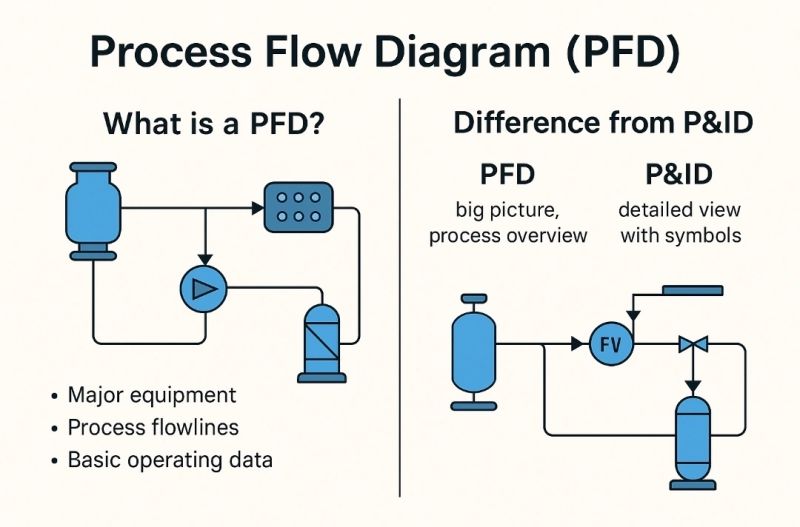
Many professionals confuse Process Flow Diagrams (PFDs) with P&IDs.
| Feature | PFD | P&ID |
|---|---|---|
| Level of Detail | Basic | Detailed |
| Equipment | Yes | Yes |
| Instrumentation | Limited | Complete |
| Valves | Limited | Detailed |
| Control Loops | No | Yes |
| Maintenance Use | Limited | Extensive |
| Validation Use | Limited | High |
A PFD provides an overview, whereas a P&ID in pharmaceutical industry provides complete engineering details.
Main Components of a P&ID
1. Process Equipment
Process equipment represents the major units involved in pharmaceutical manufacturing.
Examples include:
- Reactors
- Mixers
- Tanks
- Vessels
- Heat exchangers
- Filters
- Pumps
Each equipment item has a unique identification number.
2. Piping Systems
Pipes connect different equipment and transport materials throughout the plant.
A P&ID in pharmaceutical industry shows:
- Pipe size
- Pipe material
- Flow direction
- Line number
- Utility connections
Proper piping identification improves operation and maintenance efficiency.
3. Valves
Valves control fluid movement within the process.
Common valve types include:
- Ball valves
- Butterfly valves
- Gate valves
- Diaphragm valves
- Control valves
In pharmaceutical applications, diaphragm valves are commonly used because they reduce contamination risks.
4. Instruments
Instruments monitor and control process conditions.
Examples:
- Pressure indicators
- Temperature indicators
- Flow transmitters
- Level sensors
Instrumentation is one of the most critical sections of a P&ID in pharmaceutical industry.
5. Control Loops
Control loops automatically regulate process parameters.
Examples:
- Temperature control loop
- Pressure control loop
- Flow control loop
Control loops ensure consistent manufacturing performance.
Common P&ID Symbols Used in Pharmaceutical Industry
Understanding symbols is essential when reading a P&ID.
| Symbol Type | Example |
|---|---|
| Pump | Fluid transfer |
| Tank | Storage vessel |
| Valve | Flow control |
| Flow Meter | Flow measurement |
| Pressure Indicator | Pressure monitoring |
| Heat Exchanger | Temperature control |
| Filter | Particle removal |
Engineers should become familiar with these symbols before working with pharmaceutical systems.
Applications of P&ID in Pharmaceutical Industry
Purified Water Systems
P&IDs are extensively used in purified water generation and distribution systems.
The diagram shows:
- Storage tanks
- Pumps
- UV systems
- Filters
- Distribution loops
Clean Steam Systems
Clean steam systems rely heavily on P&ID documentation.
Engineers use the diagram to identify:
- Steam generators
- Condensate lines
- Control valves
- Pressure monitoring instruments
HVAC Systems
HVAC systems maintain clean room environmental conditions.
P&IDs help visualize:
- Air handling units
- Dampers
- Filters
- Sensors
- Control systems
API Manufacturing
API manufacturing facilities use complex process equipment.
P&IDs support:
- Batch production
- Utility management
- Safety reviews
- Process optimization
Role of P&ID During Validation
P&ID in pharmaceutical industry plays a vital role during validation and qualification activities. Validation is a regulatory requirement that ensures pharmaceutical systems, equipment, and processes consistently perform according to predetermined specifications. Since a Piping and Instrumentation Diagram (P&ID) provides detailed information about equipment, piping networks, instruments, valves, and control systems, it serves as one of the most important reference documents throughout the validation lifecycle.
Validation teams use P&IDs to verify system design, confirm equipment installation, identify critical process parameters, and demonstrate that manufacturing systems operate reliably and consistently. Without accurate and updated P&IDs, validation activities can become difficult, time-consuming, and prone to errors.
1. Design Qualification (DQ)
Design Qualification (DQ) is the first stage of qualification and focuses on verifying that the proposed system design meets user requirements, regulatory expectations, and process needs.
During DQ, validation and engineering teams review P&IDs to ensure that:
- Equipment is correctly selected for the intended process.
- Utility connections are properly designed.
- Process flow paths are appropriate.
- Critical instruments are included.
- Control systems meet operational requirements.
- Safety devices are installed as required.
For example, in a purified water system, the P&ID helps verify that storage tanks, pumps, filters, UV units, and distribution loops are properly designed to meet pharmaceutical standards.
A well-prepared P&ID helps identify design issues early in the project, reducing costly modifications later.
2. Installation Qualification (IQ)
Installation Qualification (IQ) verifies that equipment and systems have been installed according to approved design specifications.
P&ID in pharmaceutical industry serves as a key reference document during IQ because it provides detailed information about:
- Equipment locations
- Pipe routing
- Valve installation
- Instrument placement
- Utility connections
- Process line identification
Validation teams compare the actual installation against the approved P&ID to confirm that all components have been installed correctly.
For example, during purified water system qualification, the P&ID helps verify that all pumps, tanks, sampling points, instruments, and pipelines are installed exactly as specified in the design documents.
Any discrepancies identified during IQ can be documented and corrected before proceeding to the next qualification stage.
3. Operational Qualification (OQ)
Operational Qualification (OQ) demonstrates that equipment and systems operate according to their intended design under specified operating conditions.
During OQ, validation teams use P&IDs to identify:
- Control loops
- Process instruments
- Alarm systems
- Interlocks
- Operating ranges
- Critical process parameters
The P&ID provides a detailed map of system controls and instrumentation, allowing validation personnel to develop comprehensive test protocols.
For example, in a clean steam generation system, OQ testing may include verification of:
- Pressure control
- Temperature monitoring
- Flow control
- Alarm functionality
- Instrument calibration
The P&ID helps ensure that all operational functions are properly tested and documented.
4. Performance Qualification (PQ)
Performance Qualification (PQ) demonstrates that a system consistently performs as intended under routine operating conditions.
P&ID in pharmaceutical industry supports PQ by helping validation teams understand:
- Process flow paths
- Critical equipment
- Sampling locations
- Utility distribution systems
- Process monitoring points
During PQ studies, the P&ID is used to identify critical control points where data should be collected and evaluated.
For example, in a Water for Injection (WFI) distribution system, the P&ID helps determine sampling locations throughout the loop to verify consistent water quality during routine operation.
Successful PQ demonstrates that the validated system can consistently produce results that meet predetermined acceptance criteria.
Identification of Critical Process Parameters
One of the most important roles of P&IDs during validation is identifying Critical Process Parameters (CPPs) and Critical Quality Attributes (CQAs).
Examples include:
- Temperature
- Pressure
- Flow rate
- Conductivity
- Differential pressure
- Tank levels
The P&ID clearly shows where these parameters are measured and controlled, allowing validation teams to establish appropriate monitoring strategies.
Support for Risk Assessment
Risk assessment is a key part of pharmaceutical validation. P&IDs help validation teams perform risk analysis by identifying:
- Critical equipment
- Potential failure points
- Safety systems
- Process controls
- Utility interfaces
This information is frequently used during risk assessment exercises such as Failure Mode and Effects Analysis (FMEA) and Hazard Analysis studies.
Assistance During Regulatory Inspections
Regulatory inspectors often review validation documentation to ensure that pharmaceutical systems are properly qualified.
P&IDs provide inspectors with a clear understanding of:
- System design
- Process controls
- Equipment configuration
- Instrumentation layout
- Utility distribution
Accurate and up-to-date P&IDs demonstrate strong engineering control and support successful regulatory inspections.
Importance of Maintaining Updated P&IDs
Any modification to equipment, piping, instrumentation, or control systems should be reflected in the P&ID through a formal change control process.
Outdated P&IDs can create significant validation challenges, including:
- Incorrect testing protocols
- Inaccurate system understanding
- Regulatory observations
- Increased qualification time
- Compliance risks
Therefore, pharmaceutical companies must ensure that P&IDs remain current and accurately reflect the actual installation.
Key Takeaway
P&ID in pharmaceutical industry is an essential document throughout the validation lifecycle. From Design Qualification (DQ) and Installation Qualification (IQ) to Operational Qualification (OQ) and Performance Qualification (PQ), P&IDs provide the technical foundation needed to verify that pharmaceutical systems are properly designed, installed, operated, and maintained. Accurate P&IDs improve validation efficiency, support regulatory compliance, reduce project risks, and help ensure consistent manufacturing performance.
Benefits of P&ID in Pharmaceutical Industry
P&ID in pharmaceutical industry offers numerous benefits throughout the lifecycle of a pharmaceutical facility, from design and construction to operation, maintenance, validation, and regulatory compliance. A well-prepared Piping and Instrumentation Diagram serves as a valuable reference document that helps engineers, operators, maintenance teams, and quality professionals understand and manage complex manufacturing systems effectively.
The following are some of the major benefits of using P&ID in pharmaceutical industry.
1. Improved Process Understanding
One of the biggest advantages of P&ID in pharmaceutical industry is improved process understanding. Pharmaceutical manufacturing facilities often contain complex systems consisting of reactors, storage tanks, pumps, filters, heat exchangers, valves, instruments, and utility networks.
A P&ID provides a detailed visual representation of how these components are connected and how materials flow throughout the process. Engineers and operators can quickly understand system design, process flow paths, equipment interactions, and control strategies without physically tracing pipelines throughout the facility.
This improved understanding helps personnel operate systems more efficiently, make informed decisions, and reduce the risk of operational errors. For new employees and trainees, P&IDs are excellent learning tools that simplify complex manufacturing processes.
2. Better Troubleshooting
Troubleshooting process issues can be challenging in large pharmaceutical facilities where multiple systems operate simultaneously. P&ID in pharmaceutical industry helps maintenance and engineering teams quickly identify the source of problems and take corrective action.
When a system failure occurs, personnel can use the P&ID to:
- Trace process flow paths
- Identify affected equipment
- Locate valves and instruments
- Review control loops
- Understand utility connections
For example, if a pump stops functioning or a pressure alarm is triggered, the P&ID allows engineers to quickly investigate related components and determine the root cause. Faster troubleshooting reduces production interruptions and improves operational efficiency.
3. Enhanced Safety
Safety is a critical priority in pharmaceutical manufacturing because many processes involve chemicals, solvent recovery, steam, compressed gases, high temperatures, and pressurized systems.
P&ID in pharmaceutical industry enhances safety by clearly identifying critical safety devices and control systems, including:
- Pressure relief valves
- Safety valves
- Emergency shutdown systems
- Alarm systems
- Interlocks
- Isolation valves
Engineers use P&IDs during safety reviews, hazard analyses, and risk assessments to identify potential risks and implement preventive measures. By providing a clear understanding of safety-critical components, P&IDs help reduce accidents, equipment damage, and product contamination risks.
4. Regulatory Compliance
Pharmaceutical companies must comply with strict regulations established by authorities such as the US FDA, WHO, EMA, MHRA, and CDSCO. Accurate engineering documentation is an important part of regulatory compliance.
P&ID in pharmaceutical industry supports compliance with Good Manufacturing Practice (GMP) requirements by providing documented evidence of:
- Process design
- Equipment configuration
- Instrumentation systems
- Utility distribution
- Process controls
During audits and inspections, regulatory authorities frequently review P&IDs to evaluate system design and engineering controls. Well-maintained P&IDs demonstrate a company’s commitment to quality, compliance, and operational excellence.
5. Efficient Maintenance
Maintenance activities become much more efficient when accurate P&IDs are available. Pharmaceutical facilities may contain hundreds of instruments, valves, pumps, sensors, and process lines that require routine inspection and maintenance.
P&IDs help maintenance personnel:
- Locate equipment quickly
- Identify valve positions
- Trace pipelines
- Understand system connections
- Plan maintenance activities
- Reduce maintenance errors
Instead of spending valuable time searching for components, technicians can use the P&ID as a guide to navigate the system efficiently. This improves productivity and helps ensure that maintenance work is completed correctly.
6. Reduced Downtime
Unexpected equipment failures and process interruptions can result in significant production losses. P&ID in pharmaceutical industry helps reduce downtime by providing accurate and reliable information needed for troubleshooting, maintenance, and repairs.
When issues arise, engineering and maintenance teams can quickly access system information and identify corrective actions. This reduces the time required to diagnose problems and restore normal operation.
In addition, updated P&IDs support preventive maintenance programs by helping teams identify critical equipment and plan maintenance activities before failures occur. Reduced downtime leads to improved production efficiency and better utilization of manufacturing resources.
7. Support for Validation Activities
Validation is a key requirement in pharmaceutical manufacturing. P&IDs are extensively used during Design Qualification (DQ), Installation Qualification (IQ), Operational Qualification (OQ), and Performance Qualification (PQ).
Validation teams rely on P&IDs to:
- Verify system design
- Confirm equipment installation
- Identify critical process parameters
- Develop qualification protocols
- Document testing activities
Accurate P&IDs improve validation efficiency and help ensure compliance with regulatory expectations.
8. Better Change Control Management
Pharmaceutical manufacturing systems frequently undergo modifications and upgrades. Whenever changes are made to equipment, piping, instrumentation, or control systems, corresponding updates must be reflected in engineering documentation.
P&IDs support effective change control by providing an accurate representation of the current system configuration. Updated P&IDs help prevent confusion, reduce operational risks, and maintain compliance throughout the lifecycle of the facility.
9. Improved Communication Between Departments
P&IDs serve as a common technical language that can be understood by multiple departments, including:
- Engineering
- Production
- Maintenance
- Validation
- Quality Assurance
- Quality Control
Because everyone refers to the same document, communication becomes more effective and misunderstandings are minimized. This improves collaboration and supports smooth plant operations.
10. Long-Term Operational Excellence
Ultimately, P&ID in pharmaceutical industry contributes to long-term operational excellence. By supporting process understanding, troubleshooting, safety, maintenance, validation, and compliance, P&IDs help pharmaceutical companies operate more efficiently and consistently.
Organizations that maintain accurate and up-to-date P&IDs often experience:
- Better process control
- Higher equipment reliability
- Improved product quality
- Reduced operational risks
- Greater regulatory confidence
Key Takeaway
P&ID in pharmaceutical industry is much more than a technical drawing. It is a powerful engineering tool that improves process understanding, enhances safety, supports regulatory compliance, simplifies maintenance, reduces downtime, and strengthens validation activities. Properly maintained P&IDs help pharmaceutical companies achieve operational efficiency, product quality, and regulatory success while ensuring the safe and reliable manufacture of pharmaceutical products.
Common Challenges in Reading P&IDs
Many beginners face difficulties understanding P&IDs.
Common challenges include:
- Complex symbols
- Large diagrams
- Instrument identification
- Control loop interpretation
- Utility system integration
Regular practice improves understanding significantly.
Best Practices for Using P&IDs
To maximize effectiveness:
Keep Documents Updated
Always use the latest approved version.
Follow Standard Symbols
Use recognized engineering standards.
Train Personnel
Ensure operators understand P&ID basics.
Verify During Modifications
Update diagrams whenever process changes occur.
Integrate with Validation Documents
Maintain consistency across qualification records.
P&ID and GMP Compliance
P&ID in pharmaceutical industry supports Good Manufacturing Practice (GMP) compliance by providing documented evidence of process design and control.
GMP inspectors often review engineering drawings to verify:
- Equipment identification
- Utility systems
- Process controls
- Instrument calibration points
- Critical process parameters
Accurate P&IDs improve inspection readiness and demonstrate strong engineering control.
Career Importance of Learning P&ID
Knowledge of P&ID is valuable for:
- Pharma engineers
- Validation engineers
- Production professionals
- Maintenance engineers
- Utility engineers
- Quality professionals
Many pharmaceutical companies include P&ID-related questions during interviews.
Conclusion
P&ID in pharmaceutical industry is one of the most critical engineering documents used for designing, operating, validating, and maintaining pharmaceutical manufacturing facilities. It provides detailed information about process equipment, piping systems, instrumentation, valves, and control loops that ensure safe and efficient operation.
From purified water systems and HVAC units to API manufacturing plants and clean steam systems, P&IDs serve as the foundation of process understanding and regulatory compliance. Professionals who understand P&IDs can troubleshoot problems faster, support validation activities effectively, and contribute to overall manufacturing excellence.
As pharmaceutical facilities continue to become more advanced and automated, the importance of P&ID in pharmaceutical industry will continue to grow, making it an essential skill for every pharmaceutical engineering professional.
Frequently Asked Questions (FAQs)
What does P&ID stand for?
P&ID stands for Piping and Instrumentation Diagram.
Why is P&ID important in pharmaceutical industry?
It provides detailed information about equipment, piping, instruments, valves, and control systems used in pharmaceutical manufacturing.
What is the difference between PFD and P&ID?
A PFD provides basic process flow information, while a P&ID contains detailed engineering and instrumentation information.
Who uses P&IDs in pharmaceutical companies?
Engineers, operators, validation teams, maintenance personnel, quality professionals, and auditors use P&IDs.
Is P&ID required for GMP compliance?
Yes. P&IDs are important engineering documents that support GMP compliance, validation, and regulatory inspections.