What Is CIP and SIP in Pharma?
Maintaining cleanliness and sterility is one of the most critical requirements in pharmaceutical manufacturing. Every pharmaceutical product must be manufactured under controlled hygienic conditions to ensure patient safety, product quality, and compliance with Good Manufacturing Practices (GMP). One of the most effective methods used by pharmaceutical companies to achieve this objective is CIP and SIP in Pharma.
CIP and SIP in Pharma are automated cleaning and sterilization techniques used to clean and sterilize equipment without dismantling it. These systems save time, improve process efficiency, reduce contamination risks, and ensure compliance with international regulatory standards such as US FDA, WHO, EU GMP, and PIC/S.
Whether manufacturing tablets, capsules, injectables, APIs, vaccines, or biotechnology products, pharmaceutical companies rely on CIP and SIP in Pharma to maintain equipment hygiene and microbial control.
This comprehensive guide explains everything you need to know about CIP and SIP in Pharma, including their principles, working process, equipment, validation, documentation, regulatory requirements, advantages, challenges, and best practices.
Why Are CIP and SIP Important in Pharma?
Pharmaceutical manufacturing involves direct contact between equipment and medicinal products. Any residue from a previous batch or microbial contamination can compromise product quality and patient safety. Therefore, cleaning and sterilization are mandatory before manufacturing the next batch.
The implementation of CIP and SIP in Pharma helps manufacturers:
- Prevent cross-contamination between products
- Maintain aseptic processing conditions
- Reduce manual cleaning errors
- Improve production efficiency
- Meet GMP requirements
- Ensure regulatory compliance
- Reduce equipment downtime
- Improve operator safety
Because cleaning and sterilization directly affect product quality, regulatory agencies require pharmaceutical companies to validate and document every CIP and SIP in Pharma cycle.
What Is CIP in Pharma?
Clean-In-Place (CIP) is an automated cleaning process used to remove product residues, dirt, cleaning chemicals, microorganisms, and contaminants from the internal surfaces of pharmaceutical equipment without dismantling the system.
Instead of manually opening tanks and pipelines, cleaning solutions circulate through the equipment under controlled conditions of temperature, flow rate, pressure, concentration, and contact time.
CIP systems are widely used for cleaning:
- Mixing vessels
- Reactors
- Storage tanks
- Transfer pipelines
- Heat exchangers
- Granulators
- Fluid Bed Dryers
- Homogenizers
- API manufacturing equipment
- Liquid manufacturing lines
The main objective of CIP is to prepare equipment for the next production batch while maintaining product quality and regulatory compliance.
Objectives of CIP
The major objectives of Clean-In-Place include:
- Removal of product residues
- Elimination of cleaning chemical residues
- Prevention of cross-contamination
- Reduction of microbial contamination
- Increased equipment availability
- Reduced manual cleaning
- Consistent cleaning performance
- GMP compliance
- Improved operator safety
An effective CIP system ensures that every product-contact surface is thoroughly cleaned before production begins.
What Is SIP in Pharma?
Sterilization-In-Place (SIP) is an automated sterilization process used after cleaning to eliminate microorganisms from the internal surfaces of pharmaceutical equipment without dismantling it.
While CIP removes visible residues and contaminants, SIP destroys bacteria, fungi, viruses, and bacterial spores using saturated clean steam or another validated sterilization method.
SIP is particularly important for sterile pharmaceutical manufacturing where microbial contamination must be completely eliminated.
SIP is commonly used in:
- Injectable manufacturing plants
- Vaccine production facilities
- Biotechnology plants
- Fermentation systems
- Water for Injection (WFI) systems
- Purified Water loops
- Sterile storage vessels
- Filling machines
- Transfer pipelines
Objectives of SIP
The primary objectives of Sterilization-In-Place are:
- Destroy microorganisms
- Achieve sterility assurance
- Maintain aseptic conditions
- Prevent microbial contamination
- Support sterile manufacturing
- Meet regulatory expectations
- Ensure patient safety
Unlike cleaning, sterilization focuses on microbial destruction rather than residue removal.
Working Principle of CIP and SIP in Pharma
The principle of CIP and SIP in Pharma is based on automation and repeatability.
During CIP, cleaning solutions circulate through equipment under controlled conditions to dissolve, detach, and flush away residues.
Cleaning efficiency depends on four important factors known as Sinner’s Circle:
1. Time
The cleaning solution must remain in contact with equipment surfaces long enough to remove residues effectively.
2. Temperature
Higher temperatures improve cleaning efficiency by increasing chemical activity and dissolving residues faster.
3. Chemical Concentration
Appropriate concentrations of alkaline, acidic, or detergent solutions are necessary for effective cleaning.
4. Mechanical Action
Flow velocity and turbulence create mechanical force that removes deposits from internal surfaces.
Balancing these four parameters ensures successful CIP performance.
After cleaning is completed, SIP uses saturated steam to sterilize equipment by exposing all product-contact surfaces to a validated temperature for a predetermined holding time.
Components of a CIP System
A modern CIP system consists of several interconnected components designed to automate the cleaning process.
Major components include:
- CIP Solution Tanks
- Purified Water Tank
- Caustic Solution Tank
- Acid Solution Tank
- Recovery Tank
- CIP Pump
- Heat Exchanger
- Spray Balls or Rotary Spray Heads
- Flow Meter
- Conductivity Meter
- Temperature Sensors
- Pressure Gauges
- Automated Valves
- PLC Control System
Each component ensures controlled circulation of cleaning solutions throughout the equipment.
Components of a SIP System
A SIP system contains specialized equipment designed to generate, distribute, and monitor sterile steam.
Major components include:
- Clean Steam Generator
- Steam Distribution Piping
- Pressure Control Valves
- Steam Traps
- Temperature Sensors
- Pressure Indicators
- Condensate Drain System
- Air Vent Filters
- PLC Control System
Proper steam quality and uniform heat distribution are essential for successful sterilization.
Types of CIP Systems
Depending on manufacturing requirements, pharmaceutical companies use different types of CIP systems.
Single-Use CIP System
Fresh cleaning solution is used for each cleaning cycle and discarded after use.
Advantages
- Lower contamination risk
- Simple operation
- Suitable for highly potent products
Reuse CIP System
Cleaning solution is recovered, filtered, and reused for multiple cleaning cycles.
Advantages
- Lower operating cost
- Reduced water consumption
- Environmentally friendly
Centralized CIP System
One centralized CIP station supplies cleaning solutions to multiple production lines.
Advantages
- Easy monitoring
- Reduced maintenance
- Higher automation
Decentralized CIP System
Each production area has an independent CIP unit.
Advantages
- Greater flexibility
- Reduced cross-contamination risk
- Faster cleaning cycles
Step-by-Step CIP Process
A standard Clean-In-Place cycle consists of several sequential steps designed to remove all residues and prepare equipment for sterilization.
Step 1: Pre-Rinse
The cleaning process begins with a pre-rinse using purified water or Water for Injection (WFI). This removes loose product residues, dust, and soluble materials from the equipment surfaces. It also prepares the system for effective chemical cleaning by reducing the overall contamination load.
Step 2: Alkaline Wash
An alkaline cleaning solution, such as sodium hydroxide, is circulated through the equipment at a controlled temperature and flow rate. This step removes organic residues, proteins, oils, fats, and sugars that may remain after the pre-rinse. The cleaning solution is maintained for a validated contact time to ensure effective cleaning.
Step 3: Intermediate Rinse
After the alkaline wash, the system is rinsed with purified water to remove all traces of the cleaning solution. Conductivity measurements are often used to confirm complete removal of the alkaline chemicals.
Step 4: Acid Wash (If Required)
For equipment prone to mineral scaling or inorganic deposits, an acid cleaning solution (such as nitric acid or phosphoric acid) is circulated. This step removes scale, rust, and mineral residues that alkaline solutions cannot effectively eliminate.
Step 5: Final Rinse
A final rinse with Purified Water or Water for Injection (WFI) removes any remaining traces of cleaning agents. The rinse water is tested to verify that conductivity, pH, and residue levels meet predefined acceptance criteria.
Step 6: Drying or Drainage
After cleaning, the equipment is completely drained and dried using sterile air or nitrogen if required. Proper drying prevents microbial growth before the sterilization process begins.
Step-by-Step SIP Process
After the completion of the Clean-In-Place (CIP) cycle, the equipment must be sterilized before it can be used for manufacturing sterile pharmaceutical products. This is achieved through Sterilization-In-Place (SIP). SIP uses clean saturated steam to destroy microorganisms, including bacteria, fungi, viruses, and bacterial spores, without dismantling the equipment.
A validated SIP cycle consists of the following steps:
Step 1: Equipment Preparation
Before starting the SIP cycle, the equipment is inspected to ensure that the CIP process has been completed successfully. All cleaning agents must be completely removed, and the system should be properly drained. Operators verify that valves, pipelines, filters, and sensors are correctly installed and functioning.
Equipment preparation also includes checking the integrity of steam traps, pressure gauges, temperature sensors, and condensate drainage systems. Any trapped water or air pockets should be eliminated because they can reduce sterilization efficiency.
Step 2: Air Removal
Air acts as an insulator and prevents proper steam penetration. Therefore, the first stage of SIP involves removing air from the equipment using steam displacement or vacuum systems.
Proper air removal ensures that saturated steam reaches every internal surface, including dead legs, valves, and difficult-to-access areas.
Step 3: Steam Introduction
Once the air is removed, clean saturated steam generated from a pharmaceutical-grade steam generator is introduced into the equipment.
Steam flows through:
- Reactors
- Mixing vessels
- Storage tanks
- Pipelines
- Filters
- Filling machines
- Bioreactors
The steam pressure and flow rate are carefully controlled to ensure uniform distribution throughout the system.
Step 4: Heating Phase
During this phase, the equipment temperature gradually increases until every critical location reaches the validated sterilization temperature.
The commonly used sterilization temperature is:
- 121°C for approximately 15–30 minutes
However, the actual sterilization temperature and holding time depend on the product, equipment design, and validation protocol.
Temperature sensors installed at multiple locations verify that all parts of the equipment have reached the required temperature.
Step 5: Holding Time
Once the required sterilization temperature has been achieved, the equipment is maintained at that temperature for a predetermined holding time.
This stage is critical because microbial destruction depends on both temperature and exposure time.
During the holding period, operators continuously monitor:
- Temperature
- Steam pressure
- Time
- Condensate removal
All parameters are automatically recorded by the control system for validation purposes.
Step 6: Cooling Phase
After successful sterilization, steam flow is stopped and the equipment is cooled gradually.
Cooling may be performed using:
- Sterile filtered air
- Nitrogen
- Controlled cooling systems
Rapid cooling is avoided because it may create vacuum conditions that could draw contaminants into the equipment.
Step 7: Sterile Hold
After cooling, the equipment remains under positive sterile pressure until manufacturing begins.
This sterile hold condition prevents contamination before product manufacturing starts.
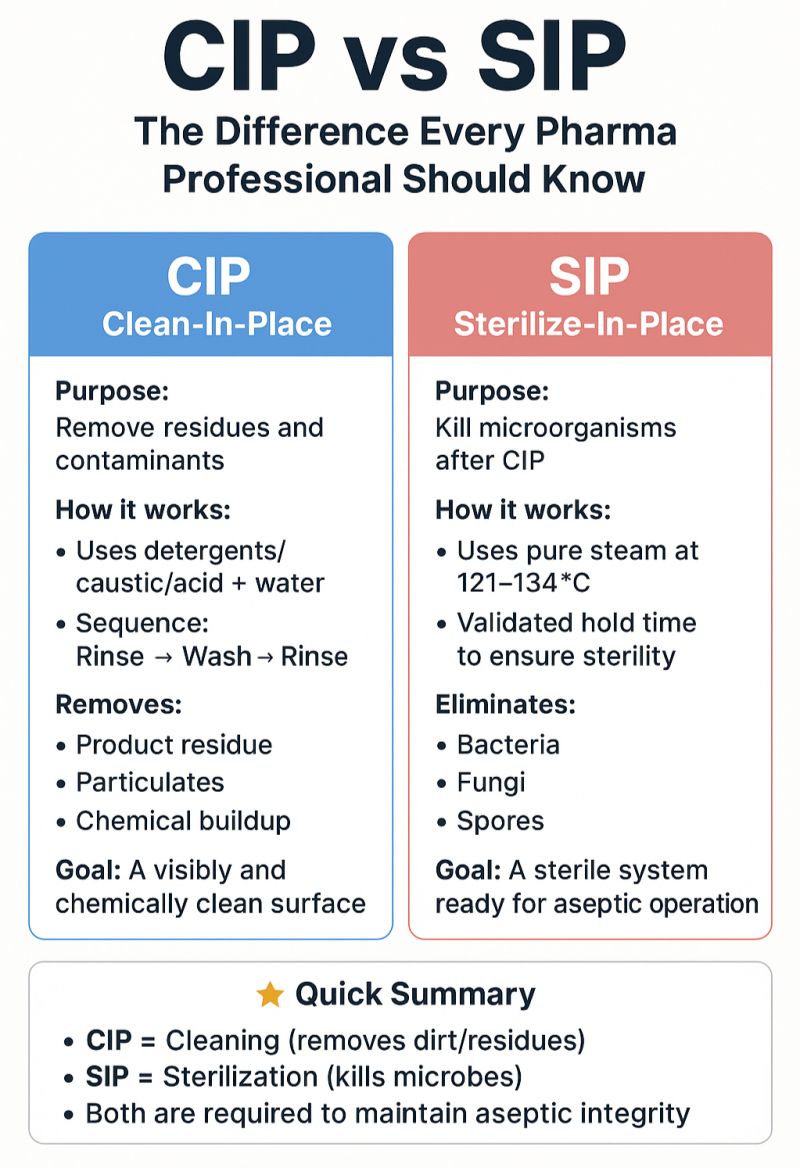
Difference Between CIP and SIP in Pharma
Although both processes work together, they serve completely different purposes.
| Parameter | CIP | SIP |
|---|---|---|
| Full Form | Clean-In-Place | Sterilization-In-Place |
| Main Purpose | Cleaning | Sterilization |
| Removes | Product residues, dirt, chemicals | Microorganisms |
| Uses | Water and cleaning chemicals | Clean saturated steam |
| Performed | First | After CIP |
| Target | Clean equipment | Sterile equipment |
| Validation | Cleaning validation | Sterilization validation |
The combination of CIP and SIP ensures that pharmaceutical equipment is both clean and sterile before production.
Equipment Used for CIP and SIP in Pharma
Modern pharmaceutical plants use highly automated systems for CIP and SIP operations.
Equipment Used in CIP
Common equipment includes:
- CIP Supply Tank
- Chemical Storage Tank
- Recovery Tank
- Circulation Pump
- Heat Exchanger
- Spray Ball
- Rotary Spray Head
- Conductivity Meter
- Flow Meter
- Temperature Sensor
- PLC Control Panel
- Automated Valves
These components ensure controlled cleaning cycles with minimal operator intervention.
Equipment Used in SIP
Sterilization systems include:
- Clean Steam Generator
- Steam Distribution Lines
- Steam Traps
- Pressure Reducing Valve
- Sterile Filters
- Temperature Sensors
- Pressure Gauges
- Condensate Drain System
- PLC Automation System
Each component plays an important role in achieving effective sterilization.
Validation of CIP and SIP in Pharma
Validation is one of the most critical regulatory requirements in pharmaceutical manufacturing.
Validation provides documented evidence that CIP and SIP in Pharma consistently perform as intended.
CIP Validation
Cleaning validation demonstrates that equipment cleaning effectively removes residues to predefined acceptable limits.
Objectives
- Ensure product residues are removed
- Eliminate cleaning agent residues
- Prevent cross-contamination
- Demonstrate cleaning consistency
Tests Performed During CIP Validation
- Visual Inspection
- Swab Sampling
- Rinse Sampling
- Total Organic Carbon (TOC)
- Conductivity Testing
- pH Testing
- Residual API Analysis
Acceptance criteria are established based on toxicological evaluation and cleaning validation protocols.
SIP Validation
Sterilization validation confirms that microbial contamination is eliminated during the sterilization process.
Common SIP Validation Activities
- Temperature Mapping
- Heat Distribution Study
- Heat Penetration Study
- Steam Quality Testing
- Biological Indicator Testing
- Chemical Indicator Verification
- Sterility Assurance Evaluation
Successful validation proves that the sterilization cycle consistently achieves the required Sterility Assurance Level (SAL).
Documentation Required for CIP and SIP
Documentation is essential for regulatory compliance and audit readiness.
Every cleaning and sterilization activity must be documented according to Good Documentation Practices (GDP).
Important documents include:
- Standard Operating Procedures (SOPs)
- Cleaning Validation Protocol
- Cleaning Validation Report
- Sterilization Validation Protocol
- Sterilization Validation Report
- Equipment Logbook
- Batch Manufacturing Record (BMR)
- Preventive Maintenance Records
- Calibration Records
- Deviation Reports
- Change Control Records
- Annual Product Quality Review (APQR)
Accurate documentation ensures traceability and demonstrates compliance during inspections.
Regulatory Guidelines for CIP and SIP
Regulatory authorities require pharmaceutical manufacturers to establish scientifically validated cleaning and sterilization procedures.
The major regulatory guidelines include:
US FDA
The FDA expects manufacturers to validate cleaning procedures and maintain documented evidence demonstrating equipment cleanliness and sterility.
WHO GMP
The World Health Organization emphasizes validated cleaning procedures, contamination prevention, and proper documentation.
EU GMP Annex 15
Annex 15 requires cleaning validation based on scientific evidence, risk assessment, and lifecycle management.
PIC/S Guidelines
PIC/S recommends risk-based cleaning validation, documented procedures, and continuous monitoring of cleaning effectiveness.
ICH Q9 (Quality Risk Management)
ICH Q9 encourages pharmaceutical manufacturers to apply risk assessment techniques while designing cleaning and sterilization procedures.
Advantages of CIP and SIP in Pharma
The implementation of automated cleaning and sterilization systems provides several operational and regulatory benefits.
- Improved Product Quality: Validated cleaning eliminates residues and reduces contamination risks, ensuring consistent product quality.
- Enhanced Patient Safety: Proper sterilization minimizes microbial contamination, protecting patients from unsafe pharmaceutical products.
- Reduced Human Error: Automation significantly reduces manual intervention, minimizing operator-related mistakes.
- Lower Production Downtime: Cleaning without dismantling equipment shortens turnaround time and increases production efficiency.
- Regulatory Compliance: Validated CIP and SIP systems help companies comply with FDA, WHO, EU GMP, and PIC/S requirements.
- Cost Savings: Although installation costs are high, automated systems reduce labor costs, water consumption, chemical usage, and production downtime over the long term.
- Increased Equipment Life: Controlled cleaning prevents excessive wear caused by manual cleaning methods, extending equipment service life.
- Improved Data Integrity: Modern automated systems automatically record cleaning parameters, making documentation more accurate and reliable.
Challenges of CIP and SIP in Pharma
Although CIP and SIP in Pharma have revolutionized pharmaceutical manufacturing by improving cleaning efficiency and sterility assurance, implementing these systems also presents several operational and technical challenges. Understanding these challenges helps pharmaceutical manufacturers optimize cleaning and sterilization processes while maintaining GMP compliance.
1. Inadequate Equipment Design
Equipment that contains dead legs, blind ends, sharp corners, or inaccessible areas can prevent cleaning solutions and steam from reaching all product-contact surfaces. Poor equipment design often results in residue accumulation and incomplete sterilization.
Solution:
- Use hygienic equipment designed according to ASME BPE and EHEDG standards.
- Minimize dead legs and ensure proper drainability.
2. Incorrect Cleaning Parameters
Cleaning efficiency depends on four critical parameters:
- Temperature
- Time
- Chemical concentration
- Flow velocity
Any deviation from validated parameters can result in ineffective cleaning.
Solution:
- Continuously monitor critical process parameters.
- Use automated PLC-controlled systems with alarms.
3. Improper Steam Quality
Poor steam quality can reduce sterilization efficiency.
Common issues include:
- Excess moisture
- Non-condensable gases
- Superheated steam
- Low steam pressure
Solution:
Perform routine steam quality testing according to EN 285 or HTM standards.
4. Inadequate Validation
Insufficient validation data may lead to regulatory observations during inspections.
Examples include:
- Poor sampling locations
- Limited validation batches
- Missing acceptance criteria
Solution:
Develop scientifically justified validation protocols based on risk assessment.
5. Human Errors
Despite automation, operator mistakes can still occur.
Examples include:
- Incorrect recipe selection
- Valve misalignment
- Incomplete documentation
- Failure to review cycle reports
Solution:
Provide regular GMP and SOP training to operators.
Best Practices for CIP and SIP in Pharma
Implementing industry best practices significantly improves cleaning efficiency, equipment reliability, and regulatory compliance.
Use Automated Control Systems
Modern PLC and SCADA systems improve consistency by controlling:
- Temperature
- Pressure
- Flow rate
- Conductivity
- Cleaning time
Automation reduces human error and improves documentation.
Develop Robust SOPs
Every cleaning and sterilization activity should be governed by approved Standard Operating Procedures (SOPs).
SOPs should clearly define:
- Equipment preparation
- Cleaning sequence
- Chemical concentration
- Steam parameters
- Safety precautions
- Acceptance criteria
Validate Every Cleaning Cycle
Validation should include:
- Worst-case product selection
- Swab sampling
- Rinse sampling
- TOC analysis
- Visual inspection
- Statistical evaluation
Validation demonstrates that the cleaning process consistently meets predefined acceptance criteria.
Perform Preventive Maintenance
Routine maintenance improves system reliability.
Maintenance activities include:
- Pump inspection
- Valve replacement
- Spray ball verification
- Steam trap maintenance
- Sensor calibration
Preventive maintenance minimizes equipment failure.
Train Personnel Regularly
Operators should receive periodic training on:
- GMP requirements
- CIP operation
- SIP operation
- Documentation practices
- Data integrity
- Cleaning validation
A well-trained workforce significantly reduces operational errors.
Monitor Cleaning Trends
Trend analysis helps identify recurring problems before they become major issues.
Monitor:
- Cleaning failures
- Water consumption
- Chemical consumption
- Cycle time
- Temperature trends
- Conductivity trends
Trend monitoring supports Continuous Process Verification (CPV).
Real Pharmaceutical Example of CIP and SIP
Consider an injectable manufacturing facility producing sterile intravenous solutions.
Step 1
A production batch is completed.
Residual product remains inside:
- Mixing vessel
- Transfer pipeline
- Holding tank
Step 2
The automated CIP system begins.
The equipment undergoes:
- Pre-rinse
- Caustic wash
- Intermediate rinse
- Acid wash
- Final rinse
Swab and rinse samples confirm that product residues are below validated acceptance limits.
Step 3
The SIP cycle starts.
Clean saturated steam at approximately 121°C is circulated throughout the system.
Temperature sensors installed at multiple locations verify that every product-contact surface reaches the required sterilization temperature.
The validated holding time is maintained.
Step 4
After cooling, the equipment remains under sterile conditions until the next manufacturing batch begins.
The complete cleaning and sterilization cycle is automatically recorded in the equipment logbook and reviewed by Quality Assurance before batch manufacturing starts.
This example illustrates how CIP and SIP in Pharma ensure both cleanliness and sterility before every production batch.
Common Mistakes During CIP and SIP
Many pharmaceutical companies experience cleaning failures because of avoidable mistakes.
Some of the most common errors include:
- Incorrect cleaning chemical concentration
- Inadequate rinse cycles
- Blocked spray balls
- Poor steam distribution
- Incorrect holding time
- Uncalibrated sensors
- Improper documentation
- Failure to investigate deviations
- Ignoring trend analysis
Identifying these issues early improves overall process reliability.
Key Takeaways
- CIP removes product residues, cleaning agents, and contaminants without dismantling equipment.
- SIP sterilizes cleaned equipment using validated clean steam cycles.
- Both processes are essential for GMP compliance, patient safety, and product quality.
- Validation, documentation, preventive maintenance, and operator training are critical for successful implementation.
- Automated CIP and SIP in Pharma systems improve efficiency, reduce contamination risks, and support regulatory inspections.
Conclusion
CIP and SIP in Pharma are essential processes that ensure pharmaceutical equipment remains clean, sterile, and ready for manufacturing high-quality medicines. While Clean-In-Place (CIP) effectively removes product residues and contaminants, Sterilization-In-Place (SIP) eliminates microorganisms using validated steam sterilization cycles. Together, these systems form the foundation of hygienic pharmaceutical manufacturing and play a crucial role in preventing cross-contamination, maintaining aseptic conditions, and ensuring compliance with global GMP regulations.
Modern pharmaceutical facilities increasingly rely on automated CIP and SIP in Pharma systems integrated with PLC and SCADA technologies to achieve consistent cleaning performance, improve operational efficiency, reduce manual intervention, and maintain complete data integrity. When supported by proper validation, preventive maintenance, Good Documentation Practices (GDP), and continuous monitoring, these systems help manufacturers meet the expectations of regulatory authorities such as the US FDA, WHO, EMA, and PIC/S.
For pharmaceutical professionals, understanding the principles, validation requirements, equipment design, and best practices of CIP and SIP in Pharma is essential for ensuring product quality, regulatory compliance, and patient safety. As the industry embraces digital transformation and smart manufacturing, automated cleaning and sterilization technologies will continue to play an even greater role in the future of pharmaceutical production.
Frequently Asked Questions (FAQ)
1. What is CIP and SIP in Pharma?
CIP (Clean-In-Place) is an automated cleaning process that removes product residues and contaminants from pharmaceutical equipment without dismantling it. SIP (Sterilization-In-Place) is a sterilization process that uses clean steam to destroy microorganisms after cleaning.
2. What is the difference between CIP and SIP?
CIP focuses on cleaning product-contact surfaces, while SIP focuses on sterilizing those surfaces. CIP is performed first, followed by SIP before manufacturing sterile pharmaceutical products.
3. Why are CIP and SIP important in pharmaceutical manufacturing?
CIP and SIP help:
- Prevent cross-contamination
- Maintain sterility
- Improve product quality
- Ensure patient safety
- Meet GMP and regulatory requirements
4. Which equipment commonly uses CIP and SIP?
Typical equipment includes:
- Reactors
- Mixing vessels
- Storage tanks
- Bioreactors
- Transfer pipelines
- Filling machines
- Water systems
- Fermenters
5. How is CIP validated?
Cleaning validation involves:
- Swab sampling
- Rinse sampling
- TOC analysis
- Visual inspection
- Residue testing
- Acceptance limit verification
6. How is SIP validated?
Sterilization validation includes:
- Temperature mapping
- Biological indicators
- Steam quality testing
- Holding time verification
- Heat penetration studies