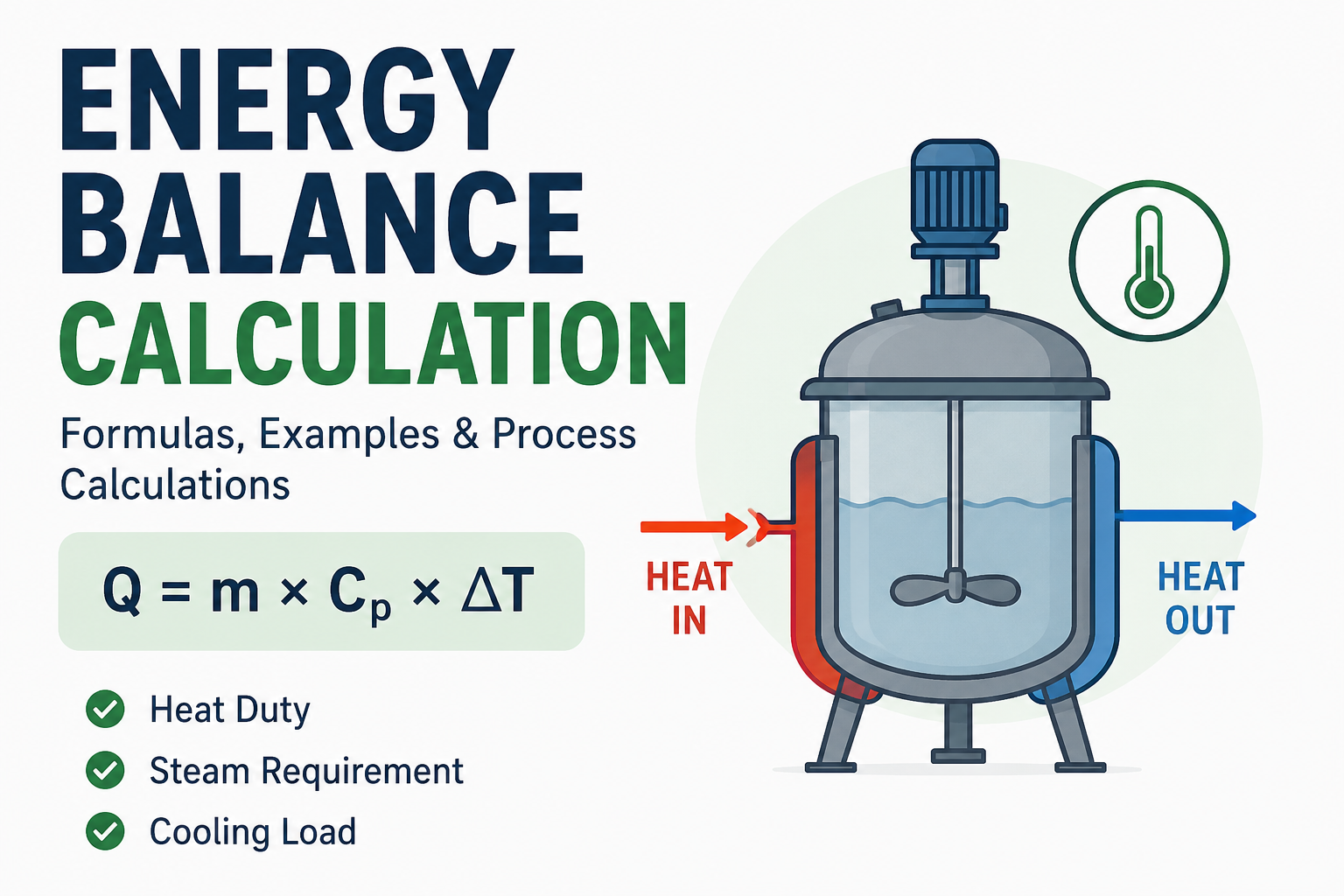
Energy Balance Calculation is one of the most important engineering calculations used in the pharmaceutical, chemical, food, oil & gas, and biotechnology industries. Every manufacturing process involves the transfer, generation, or consumption of energy in the form of heat or work. Engineers perform Energy Balance Calculations to determine the amount of heat required, cooling needed, steam consumption, utility requirements, and energy losses during process operations.
Energy Balance Calculation is based on the First Law of Thermodynamics, which states that energy can neither be created nor destroyed; it can only be transferred or converted from one form to another. This principle enables engineers to design efficient processes, size equipment such as heat exchangers and reactors, estimate utility consumption, and optimize plant performance.
In pharmaceutical manufacturing, Energy Balance Calculation is commonly applied to reactors, heat exchangers, dryers, distillation columns, evaporators, crystallizers, sterilizers, HVAC systems, and utility equipment. Accurate calculations improve product quality, reduce operating costs, and increase overall process efficiency.
This guide explains Energy Balance Calculation with formulas, engineering methods, and practical industrial calculations used by process engineers.
What is Energy Balance Calculation?
Energy Balance Calculation is the process of accounting for all forms of energy entering, leaving, generated, consumed, or accumulated within a process system.
It helps engineers calculate:
- Heat required for heating
- Cooling duty
- Steam requirement
- Chilled water requirement
- Heat exchanger duty
- Reactor heat load
- Dryer heat requirement
- Utility consumption
Principle of Energy Balance
Energy Balance Calculation follows the First Law of Thermodynamics.
The law states:
Energy can neither be created nor destroyed. It can only change from one form to another.
For any process,
Total Energy In = Total Energy Out + Energy Accumulated
General Energy Balance Equation
The general energy balance equation is:
Q−W+∑mHin=∑mHout+ΔE\boxed{Q – W + \sum mH_{in} = \sum mH_{out} + \Delta E}
Where:
- Q = Heat added to the system (kJ)
- W = Work done by the system (kJ)
- m = Mass flow rate (kg/h or kg/s)
- H = Specific enthalpy (kJ/kg)
- ΔE = Change in stored energy
For most pharmaceutical processes operating at steady state with negligible shaft work, the equation simplifies to:
Q=m×Cp×ΔT\boxed{Q = m \times C_p \times \Delta T}
where:
- QQ = Heat duty (kJ)
- mm = Mass (kg)
- CpC_p = Specific heat capacity (kJ/kg·°C)
- ΔT\Delta T = Temperature change (°C)
Types of Energy Balance
Overall Energy Balance
Used for complete plants or process sections.
Equipment Energy Balance
Performed around individual equipment such as:
- Reactors
- Heat Exchangers
- Distillation Columns
- Dryers
- Evaporators
- Crystallizers
Steady-State Energy Balance
No energy accumulation occurs with time.
Unsteady-State Energy Balance
Energy stored within the system changes with time, such as during batch heating or cooling.
Units Used in Energy Balance Calculation
| Parameter | Unit |
|---|---|
| Heat Energy | kJ |
| Heat Duty | kW |
| Mass | kg |
| Mass Flow Rate | kg/hr |
| Temperature | °C |
| Specific Heat | kJ/kg·°C |
| Latent Heat | kJ/kg |
Step-by-Step Procedure for Energy Balance Calculation
Step 1
Define the process boundary.
Step 2
Identify all inlet and outlet streams.
Step 3
Collect process data:
- Mass flow rate
- Temperature
- Pressure
- Specific heat
- Phase (liquid, vapor, or solid)
Step 4
Select the appropriate energy balance equation.
Step 5
Calculate heat duty or utility requirement.
Step 6
Verify the energy balance and compare with design data.
Energy Balance Calculation Formula
Sensible Heat
Where:
- Q = Heat required (kJ)
- m = Mass (kg)
- Cp = Specific heat (kJ/kg·°C)
- ΔT = Final temperature − Initial temperature (°C)
Example 1: Heating Water
Problem
A reactor contains 2,000 kg of purified water. The water is heated from 25°C to 80°C.
Given:
- Cp of water = 4.18 kJ/kg·°C
Calculate the heat required.
Solution
Mass,
m = 2,000 kg
Temperature rise,
ΔT = 80 − 25 = 55°C
Using the sensible heat equation:
Q = 2000 × 4.18 × 55
Q = 459,800 kJ
Final Answer
Heat Required = 459,800 kJ (459.8 MJ)
Example 2: Steam Requirement Calculation
Problem
The reactor requires 459,800 kJ of heat.
Steam latent heat = 2,100 kJ/kg
Calculate the steam required.
Formula
Steam Required
= Heat Duty ÷ Latent Heat
Calculation
Steam Required
= 459800 ÷ 2100
= 218.95 kg
Final Answer
Steam Required = 219 kg
Example 3: Cooling Water Requirement
Problem
A reactor releases 800,000 kJ/hr.
Cooling water enters at 30°C and leaves at 40°C.
Cp of water = 4.18 kJ/kg·°C
Calculate cooling water required.
Solution
ΔT = 10°C
Using:
Cooling Water
= Q ÷ (Cp × ΔT)
= 800000 ÷ (4.18 × 10)
= 800000 ÷ 41.8
= 19,139 kg/hr
Final Answer
Cooling Water Required = 19.14 TPH
Heat Exchanger Energy Balance Calculation
A heat exchanger transfers heat from one fluid to another without mixing the fluids. Engineers perform an Energy Balance Calculation to determine the heat duty, outlet temperature, steam requirement, or cooling water requirement.
The basic equation is:
Where:
- Q = Heat duty (kJ/hr)
- m = Mass flow rate (kg/hr)
- Cp = Specific heat (kJ/kg·°C)
- T₂ = Outlet temperature (°C)
- T₁ = Inlet temperature (°C)
Example 4: Heat Exchanger Duty
Problem
A pharmaceutical solution flows through a heat exchanger.
Given Data
| Parameter | Value |
|---|---|
| Flow rate | 5,000 kg/hr |
| Inlet Temperature | 30°C |
| Outlet Temperature | 85°C |
| Specific Heat | 3.90 kJ/kg·°C |
Calculate the heat duty.
Step 1
Temperature rise
ΔT
= 85 − 30
= 55°C
Step 2
Heat Duty
Q
= 5000 × 3.90 × 55
= 1,072,500 kJ/hr
Step 3
Convert to kW
1 kW = 3600 kJ/hr
Heat Duty
= 1072500 ÷ 3600
= 297.9 kW
Final Answer
| Parameter | Value |
|---|---|
| Heat Duty | 1,072,500 kJ/hr |
| Heat Duty | 297.9 kW |
Reactor Energy Balance Calculation
Chemical reactions either release heat (exothermic) or absorb heat (endothermic).
The reactor energy balance is:
Q=mCpΔT±ΔHreactionQ = mC_p\Delta T \pm \Delta H_{reaction}
Where
- Positive = Heat supplied
- Negative = Heat released
Example 5: Reactor Heating Calculation
Problem
A reactor contains 2500 kg of reaction mass.
Heating from 28°C to 75°C
Cp = 3.60 kJ/kg·°C
Calculate heating duty.
Solution
ΔT
75 − 28
= 47°C
Heat Duty
Q
= 2500 × 3.60 × 47
= 423000 kJ
Final Answer
Heating Required = 423 MJ
Reactor Cooling Calculation
Problem
After completion of the reaction,
Reaction mass
= 2500 kg
Cooling required
75°C → 30°C
Cp
= 3.75 kJ/kg°C
Solution
ΔT
75 − 30
= 45°C
Heat Removed
Q
= 2500 × 3.75 × 45
= 421875 kJ
Final Answer
Cooling Load
= 421.9 MJ
Example 6: Condenser Energy Balance
A solvent vapor is condensed.
Given
Vapor
= 1200 kg/hr
Latent Heat
= 2200 kJ/kg
Formula
Q=mλQ=m\lambda
Where
λ = Latent Heat
Calculation
Q
= 1200 × 2200
= 2,640,000 kJ/hr
Final Answer
Condenser Duty
= 2.64 GJ/hr
Example 7: Evaporator Energy Balance
Problem
Water evaporated
= 1500 kg/hr
Latent Heat
= 2257 kJ/kg
Calculate evaporator duty.
Calculation
Q
= 1500 × 2257
= 3,385,500 kJ/hr
Convert to kW
3385500 ÷ 3600
= 940.4 kW
Final Answer
Evaporator Duty
= 940.4 kW
Example 8: Dryer Energy Balance
Problem
Wet granules
= 1200 kg
Water removed
= 180 kg
Latent Heat of Water
= 2257 kJ/kg
Calculate drying energy.
Calculation
Q
= 180 × 2257
= 406260 kJ
Final Answer
Drying Energy
= 406.3 MJ
Example 9: Pharmaceutical Batch Heating
Problem
A manufacturing reactor contains
| Material | Quantity |
|---|---|
| Purified Water | 1800 kg |
| API | 350 kg |
| Solvent | 450 kg |
Average Cp
= 3.95 kJ/kg°C
Heating
25°C → 82°C
Step 1
Total Mass
1800 + 350 + 450
= 2600 kg
Step 2
Temperature Rise
82 − 25
= 57°C
Step 3
Heat Required
Q
= 2600 × 3.95 × 57
= 585390 kJ
Final Answer
Heat Required
= 585.4 MJ
Example 10: Steam Consumption for Batch Heating
Problem
Heat Duty
= 585390 kJ
Steam Latent Heat
= 2100 kJ/kg
Calculation
Steam
= 585390 ÷ 2100
= 278.8 kg
Final Answer
Steam Required
= 279 kg
Common Engineering Units Used in Energy Balance
| Parameter | Unit |
|---|---|
| Heat Duty | kJ/hr |
| Heat Load | kW |
| Steam Consumption | kg/hr |
| Cooling Water | kg/hr |
| Latent Heat | kJ/kg |
| Specific Heat | kJ/kg·°C |
| Mass Flow Rate | kg/hr |
| Temperature | °C |
Applications of Energy Balance Calculation in Pharmaceutical Industry