The Filtration Process in Pharmaceutical Industry is a critical unit operation used for separating solids from liquids, removing suspended particles, clarifying solutions, recovering crystallized APIs, and, in sterile manufacturing, removing microorganisms from suitable liquid streams.
In API and pharmaceutical manufacturing, filtration often comes immediately after reaction, crystallization, precipitation, or washing. The performance of filtration can directly affect product recovery, purity, cycle time, solvent consumption, drying efficiency, and overall manufacturing cost.
For a process engineer, filtration is not simply a matter of passing material through a filter. The engineer must understand:
- Filter media
- Filtration mechanism
- Pressure differential
- Filtration area
- Cake resistance
- Particle size
- Slurry concentration
- Viscosity
- Temperature
- Washing
- Mother liquor retention
- Equipment capacity
- Scale-up
The filtration system must also be compatible with the product and process conditions.
This article explains the Filtration Process in Pharmaceutical Industry from basic principles to commercial-scale operation, including seven important methods, equipment selection, calculations, scale-up, troubleshooting, and practical API examples.
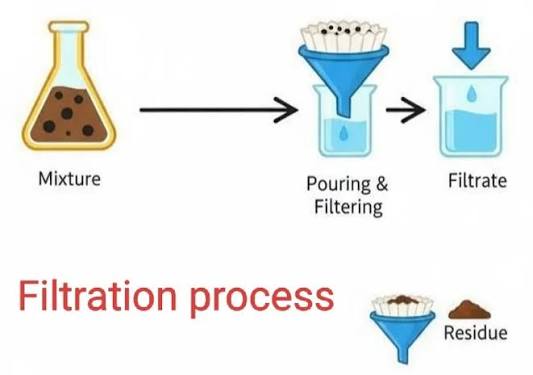
What Is the Filtration Process in Pharmaceutical Industry?
Filtration is a separation operation in which a mixture containing a solid and liquid is passed through a porous medium that allows the liquid to pass while retaining the solid particles.
A typical pharmaceutical solid-liquid filtration process can be represented as:
Slurry → Filter Medium → Filtrate + Filter Cake
Where:
- Slurry: mixture of solid particles and liquid
- Filter medium: porous material that retains solids
- Filtrate: liquid passing through the filter
- Filter cake: solids retained on the filter
For example, after API crystallization:
API crystals + mother liquor → filtration → wet API cake + mother liquor
The wet cake may then be washed and transferred to a dryer.
How Does Pharmaceutical Filtration Work?
The filtration process generally involves the following sequence:
Step 1: Prepare the slurry
The crystallized or precipitated product is maintained in a suitable liquid medium.
Step 2: Transfer the slurry
The slurry is transferred to the filtration equipment.
Step 3: Apply driving force
The liquid is forced through the filter using:
- Vacuum
- Pressure
- Gravity
- Centrifugal force
Step 4: Formation of filter cake
Solid particles accumulate on the filter medium and form a cake.
Step 5: Filtrate collection
The liquid passes through the filter and is collected as filtrate.
Step 6: Cake washing
A suitable wash solvent may be added to remove:
- Mother liquor
- Soluble impurities
- Residual reactants
- Residual color bodies
Step 7: Cake dewatering
Additional vacuum, pressure, gas displacement, or centrifugation can reduce the liquid content of the cake.
Step 8: Transfer to drying
The wet cake is transferred to a suitable dryer.
7 Key Filtration Methods Used in Pharmaceutical Manufacturing
Different filtration methods are selected according to the nature of the material and required product quality.
1. Vacuum Filtration
Vacuum filtration uses a pressure difference created by applying vacuum on the filtrate side.
Atmospheric pressure on the slurry side pushes liquid through the filter.
Basic principle
Atmospheric pressure → Slurry → Filter → Vacuum side
Vacuum filtration is commonly used when:
- Solid-liquid separation is required
- The material can tolerate the operating conditions
- Moderate filtration rates are acceptable
- A relatively simple filtration arrangement is preferred
Advantages
- Simple principle
- Useful for batch processing
- Can provide good cake dewatering
- Relatively easy operation
Limitations
- Vacuum level may be limited
- Very fine particles can create high cake resistance
- Some solvents may require suitable vacuum-system design
- Foaming can become an issue
2. Pressure Filtration
Pressure filtration uses positive pressure to force the liquid through the filter medium.
The pressure may be generated using:
- Pump
- Nitrogen
- Compressed gas
- Process pressure
Basic principle
Pressure → Slurry → Filter medium → Filtrate
Pressure filtration can provide a higher driving force than gravity filtration and is useful for many industrial solid-liquid separation applications.
Important parameters
- Filtration pressure
- Filter area
- Cake thickness
- Slurry concentration
- Filtration temperature
- Filter-media resistance
3. Nutsche Filtration
A Nutsche filter is widely used for pharmaceutical solid-liquid separation.
A typical Nutsche filter consists of:
- Vessel
- Filter plate
- Filter cloth
- Agitator or mixer
- Filtrate outlet
- Slurry inlet
- Wash arrangement
- Optional cake-scraping mechanism
A filter dryer/ANFD can combine filtration, washing and drying process in one contained system.
Typical sequence
Slurry charging → Filtration → Cake formation → Washing → Dewatering → Drying
This makes Nutsche-based systems particularly useful for pharmaceutical API manufacturing.
Advantages
- Closed operation possible
- Good containment
- Cake washing possible
- Cake drying possible with ANFD
- Reduced material handling
- Suitable for high-value APIs
4. Centrifugal Filtration
Centrifugal filtration uses centrifugal force to separate liquid from solid particles.
The slurry is charged into a centrifuge, and rotation creates a strong centrifugal force.
Typical sequence
Slurry charging → Rotation → Liquid removal → Cake formation → Washing → Dewatering → Discharge
Centrifuges are commonly used when:
- High separation efficiency is required
- Large batches need to be processed
- Crystal washing is important
- Rapid dewatering is required
Important parameters
- Basket speed
- Feed rate
- Cake thickness
- Wash volume
- Wash time
- Spin time
- Discharge method
5. Cartridge Filtration
Cartridge filters are commonly used for liquid clarification and particulate removal.
They consist of a filter cartridge installed inside a housing.
Depending on the application, cartridge filters can be made from materials such as:
- Polypropylene
- PES
- PTFE
- Nylon
- Other compatible filter materials
Applications can include:
- Solution clarification
- Final particulate removal
- Solvent filtration
- Process-water filtration
- Sterile filtration for appropriate validated applications
Filter selection must be based on compatibility and validated process requirements.
6. Membrane Filtration
Membrane filtration uses a membrane with controlled pore characteristics to separate components.
Applications include:
- Microfiltration
- Ultrafiltration
- Nanofiltration
- Sterilizing filtration for appropriate pharmaceutical applications
In sterile processing, filtration is a specialized operation requiring appropriate validation. FDA guidance states that sterilizing-grade filters must be validated for their intended process conditions and microbial-retention performance.
Important factors include:
- Filter material
- Pore rating
- Pressure
- Flow rate
- Temperature
- Product compatibility
- Maximum use time
- Product viscosity
7. Depth Filtration
Depth filters retain particles throughout the thickness of the filter medium rather than relying only on surface retention.
They can be useful for:
- Clarification
- Removal of suspended solids
- Reduction of particulate load
- Pre-filtration before finer filtration
Depth filtration can be particularly useful when the feed contains a relatively high particulate load.
Cake Filtration vs Clarifying Filtration
These are two important concepts for process engineers.
| Parameter | Cake Filtration | Clarifying Filtration |
|---|---|---|
| Main objective | Recover solids | Remove suspended particles |
| Solid loading | Usually higher | Usually lower |
| Cake formation | Important | Minimal or controlled |
| Example | API crystals | Solution clarification |
| Main concern | Filtration rate/cake resistance | Filtrate clarity |
| Typical equipment | Nutsche, centrifuge | Cartridge, depth filter |
What Is Filter Media?
The filter medium is the material through which the liquid passes while the solid is retained.
Common filter-media forms include:
- Filter cloth
- Filter paper
- Membrane
- Cartridge
- Porous metal
- Sintered material
- Depth-filter media
The correct filter medium depends on:
- Particle size
- Solvent
- Temperature
- Pressure
- Chemical compatibility
- Required filtrate quality
- Product recovery
- Cleaning requirements

How Do You Select the Right Filter?
Filter selection should consider both the product and process.
1. Particle size
Smaller particles generally require finer filtration.
2. Slurry concentration
High-solids slurries can rapidly increase cake thickness.
3. Viscosity
High-viscosity liquids normally require greater filtration driving force.
4. Temperature
Temperature can significantly affect viscosity and solubility.
5. Chemical compatibility
The filter material must withstand contact with:
- Solvents
- Acids
- Bases
- API
- Cleaning agents
6. Pressure
The filter must be mechanically suitable for the operating pressure.
7. Product recovery
Adsorption or product retention by the filter should be evaluated where relevant.
Filtration Pressure Drop
The pressure difference across the filter is an important operating parameter.
It can be represented as:
ΔP=P1−P2\Delta P=P_1-P_2
Where:
- P1P_1 = Pressure on slurry side
- P2P_2 = Pressure on filtrate side
- ΔP\Delta P = Pressure differential
For example:
If slurry-side pressure = 2.5 bar
and filtrate-side pressure = 0.5 bar,
then:
ΔP=2.5−0.5\Delta P=2.5-0.5 ΔP=2.0 bar\Delta P=2.0\ bar
Therefore, the filtration pressure differential is 2 bar.
Filtration Area Calculation
Filter area is an important parameter during equipment sizing.
A simplified relationship is:
A=QJA=\frac{Q}{J}
Where:
- AA = Filter area
- QQ = Required flow rate
- JJ = Filtration flux
Example
Suppose:
- Required flow = 10,000 L/h
- Filtration flux = 2,000 L/m²·h
Then:
A=10,0002,000A=\frac{10,000}{2,000} A=5 m2A=5\ m^2
Therefore, the theoretical filter area required is 5 m².
Actual equipment selection should include appropriate design margins and must account for the real slurry characteristics and validated operating conditions.
Practical API Filtration Example
Consider an API crystallization batch.
Batch data
| Parameter | Value |
|---|---|
| API crystals | 100 kg |
| Mother liquor | 800 L |
| Filter type | Nutsche filter |
| Filtration area | 2.5 m² |
| Filtration pressure | 1.5 bar |
| Wash solvent | 150 L |
| Expected recovery | 97% |
Process
Step 1: Transfer API slurry to the Nutsche filter.
Step 2: Start filtration.
Step 3: Allow mother liquor to pass through the filter cloth.
Step 4: Continue until the required mother-liquor removal is achieved.
Step 5: Introduce wash solvent.
Step 6: Allow the wash liquid to pass through the cake.
Step 7: Apply vacuum or pressure for dewatering.
Step 8: Discharge wet API cake.
Step 9: Transfer to the dryer.
API Recovery Calculation
Suppose:
- API charged to crystallization = 100 kg
- API recovered after filtration = 97 kg
Then:
Recovery=97100×100Recovery=\frac{97}{100}\times100 Recovery=97%Recovery=97\%
Therefore, API recovery is 97%.
The remaining 3 kg may be distributed among mother liquor losses, transfer losses, filter hold-up and other process losses.
Cake Moisture Calculation
Suppose:
- Wet cake weight = 150 kg
- Dry API weight = 100 kg
Then:
Wet cake moisture=150−100150×100Wet\ cake\ moisture=\frac{150-100}{150}\times100 =33.33%=33.33\%
Therefore, the wet cake contains approximately 33.3% liquid by wet-cake basis.
This moisture level has a direct impact on subsequent drying time.
Why Is Cake Washing Important?
After filtration, the API cake may contain mother liquor containing dissolved impurities.
Washing can remove these impurities.
Example
Suppose the API cake contains:
- API crystals
- Mother liquor
- Residual impurity
A suitable wash solvent can displace or remove the mother liquor.
The objective is to achieve:
Higher purity + acceptable API recovery
However, excessive washing may increase:
- Solvent consumption
- Cycle time
- API loss
- Waste generation
Therefore, washing must be optimized.
Washing Efficiency
A simplified washing study may evaluate:
- Wash volume
- Wash solvent
- Number of washes
- Wash temperature
- Cake thickness
- Mixing or displacement behavior
For example:
| Trial | Wash Volume | Purity | Yield |
|---|---|---|---|
| Trial 1 | 50 L | 98.5% | 98.0% |
| Trial 2 | 100 L | 99.1% | 97.5% |
| Trial 3 | 150 L | 99.5% | 96.8% |
The process engineer must select a suitable operating point rather than automatically choosing the maximum wash volume.
Mother Liquor and Filtration Losses
Mother liquor can contain a significant quantity of dissolved API.
For example:
- Mother liquor volume = 500 L
- API concentration = 5 kg/m³
Since:
500 L=0.5 m3500\ L=0.5\ m^3
API in mother liquor:
0.5×5=2.5 kg0.5\times5=2.5\ kg
Therefore, approximately 2.5 kg API is present in the mother liquor.
Possible recovery strategies include:
- Mother liquor recycling
- Secondary crystallization
- Solvent recovery
- Reprocessing
The appropriate strategy depends on product quality, economics and the approved process.
Filtration Scale-Up: Kilo Lab to Commercial Plant
Filtration scale-up is not simply a matter of multiplying the laboratory filter area.
A process engineer should evaluate:
1. Filter area
Determine required commercial filtration area based on process data.
2. Cake thickness
Cake thickness can influence filtration resistance and washing.
3. Pressure differential
The commercial equipment must provide an appropriate driving force.
4. Slurry properties
Evaluate:
- Particle size
- Solid concentration
- Viscosity
- Temperature
5. Mixing
The slurry should remain adequately suspended during transfer and filtration.
6. Filter-media behavior
The same or equivalent filter media should be evaluated under representative process conditions.
7. Washing
Wash distribution and cake characteristics should be considered.
Example of Filtration Scale-Up
Suppose a laboratory study gives:
- Filter area = 0.1 m²
- Batch size = 5 kg
- Filtration time = 30 minutes
Commercial batch size:
- 100 kg
A simple proportional approach gives:
Scale factor=1005=20Scale\ factor=\frac{100}{5}=20
Theoretical area:
A=0.1×20A=0.1\times20 A=2 m2A=2\ m^2
Therefore, a first theoretical estimate is 2 m².
However, commercial filter sizing should not rely solely on linear scale-up. Cake resistance, slurry characteristics, filtration pressure, equipment geometry and actual pilot/commercial data must be considered.
Nutsche Filter vs Centrifuge
Both are commonly used for API crystal isolation.
| Parameter | Nutsche Filter | Centrifuge |
|---|---|---|
| Driving force | Vacuum/pressure | Centrifugal force |
| Cake washing | Excellent | Excellent |
| Containment | Excellent in closed systems | Depends on design |
| Drying | ANFD can dry | Usually separate dryer |
| Automation | High | High |
| Crystal handling | Gentle | Can involve higher mechanical stress |
| Footprint | Moderate | Equipment dependent |
| Typical use | High-value API | API/intermediate isolation |
Equipment selection should be based on product characteristics and process requirements rather than using one technology universally.
Common Filtration Problems and Their Causes
Problem 1: Slow Filtration
Possible causes
- Fine particles
- High cake resistance
- Excessive cake thickness
- High viscosity
- Low pressure differential
- Blocked filter medium
- Poor crystal morphology
Corrective actions
- Review crystallization conditions
- Evaluate particle size
- Optimize slurry concentration
- Review filtration pressure
- Evaluate filter-media selection
Problem 2: Filter Blinding
Filter blinding occurs when particles block the filter medium.
Possible causes
- Very fine particles
- High solids concentration
- Poor particle-size distribution
- Excessive pressure
Possible solutions
- Optimize crystallization
- Modify particle-size distribution
- Use suitable filter media
- Optimize pressure profile
Problem 3: Poor Filtrate Clarity
Possible causes:
- Incorrect filter rating
- Filter-media damage
- Poor installation
- Excessive flow
- Very fine particles
- Filter breakthrough
The filter should be inspected and the filtration process reviewed.
Problem 4: High API Loss
Possible causes:
- API dissolved in mother liquor
- Product retained in filter media
- Excessive washing
- Transfer losses
- Product degradation
- Incorrect filtration conditions
A mass balance around the filtration step is useful for identifying the major loss source.
Problem 5: High Residual Solvent in Wet Cake
Possible causes:
- Insufficient dewatering
- High cake thickness
- Poor cake permeability
- Inadequate vacuum
- Excessive mother-liquor retention
Possible improvements include optimizing cake thickness, dewatering conditions and filtration equipment.
Problem 6: Long Filtration Cycle
A long cycle can result from:
- Slow crystallization
- Small particle size
- High cake resistance
- High slurry viscosity
- Insufficient filter area
- Inadequate driving force
The root cause should be determined before simply increasing filtration pressure.
Filtration and Drying Relationship
Filtration and drying should not be optimized independently.
Suppose two filtration conditions produce:
| Parameter | Trial A | Trial B |
|---|---|---|
| Filtration time | 60 min | 40 min |
| Wet cake moisture | 35% | 25% |
| Drying time | 10 h | 7 h |
Trial B may provide a better overall process because it improves both filtration and drying.
Therefore:
Better filtration → Lower cake moisture → Shorter drying → Lower cycle time
This is particularly important in commercial API manufacturing.
GMP Considerations for Pharmaceutical Filtration
Filtration equipment and processes should be controlled according to the applicable GMP requirements and the specific product/process.
Important areas include:
- Equipment qualification
- Cleaning procedures
- Filter identification
- Filter-media specifications
- Material compatibility
- Batch-record documentation
- Preventive maintenance
- Filter integrity where applicable
- Process validation
- Change control
- Cleaning validation where applicable
For sterile filtration, the requirements are more stringent. FDA guidance emphasizes filter validation, product/filter compatibility, microbial-retention performance and appropriate integrity testing.
For sterile processes, FDA inspection guidance also highlights the importance of filter integrity testing and investigation of integrity failures.
Sterile Filtration vs API Solid-Liquid Filtration
These two concepts should not be confused.
| Feature | Solid-Liquid Filtration | Sterile Filtration |
|---|---|---|
| Main objective | Separate solids/liquid | Remove microorganisms |
| Typical application | API crystallization | Sterile liquid product |
| Filter | Cloth, membrane, etc. | Validated sterilizing-grade filter |
| Cake formation | Usually | Usually no |
| Main concern | Recovery and filtration rate | Microbial retention and sterility assurance |
| Validation | Process-specific | Extensive filter/process validation |
Sterile filtration requires a specialized control strategy. FDA guidance describes sterilizing-grade filters as requiring validation to reproducibly remove viable microorganisms under representative process conditions.
Filtration Process Control Strategy
A robust filtration process can be controlled through three groups.
Input Controls
- Slurry concentration
- Particle size
- Solvent
- Temperature
- Viscosity
- Solid loading
Process Controls
- Pressure/vacuum
- Filtration rate
- Cake thickness
- Wash volume
- Wash time
- Dewatering time
- Filter area
Output Controls
- Product yield
- Purity
- Moisture
- Residual solvent
- Particle size
- Filtrate clarity
Filtration Mass Balance
A simple filtration mass balance can be represented as:
Solids in slurry = Solids in cake + Solids lost
For example:
- API entering filtration = 100 kg
- API recovered in cake = 97 kg
Then:
Loss=100−97Loss=100-97 Loss=3 kgLoss=3\ kg
Therefore, 3 kg of API is not recovered in the final cake.
The loss should be investigated through:
- Mother liquor analysis
- Filter hold-up
- Transfer loss
- Wash loss
- Sampling
- Equipment residuals
Filtration Troubleshooting Checklist
Before investigating a filtration failure, check:
Material
- Particle size
- Slurry concentration
- Viscosity
- Temperature
- Solid loading
Equipment
- Filter area
- Filter-media condition
- Gasket condition
- Equipment cleanliness
- Pressure capability
- Vacuum capability
Process
- Filtration pressure
- Filtration rate
- Cake thickness
- Washing volume
- Washing time
- Dewatering time
Quality
- Filtrate clarity
- API purity
- API recovery
- Moisture
- Residual solvent
- Particle size
What Should a Process Engineer Know About Filtration?
For a Senior Process Engineer, important filtration knowledge includes:
Basic concepts
- Filtration mechanism
- Cake formation
- Pressure differential
- Filter resistance
- Filtrate
- Mother liquor
Equipment
- Nutsche filter
- ANFD
- Centrifuge
- Filter press
- Cartridge filter
- Membrane filter
Calculations
- Filter area
- Filtration flux
- Pressure drop
- Cake moisture
- API recovery
- Washing volume
- Mass balance
Scale-up
- Filter area scaling
- Cake resistance
- Pressure
- Slurry properties
- Mixing
- Equipment geometry
Process optimization
- Cycle-time reduction
- Yield improvement
- Solvent reduction
- Washing optimization
- Drying-time reduction
Pharmaceutical quality
- GMP
- Cleaning
- Filter compatibility
- Validation
- Integrity testing where applicable
- Change control
- Documentation
10 Important Filtration Parameters at a Glance
| No. | Parameter | Why Important |
|---|---|---|
| 1 | Filter area | Determines capacity |
| 2 | Pressure differential | Provides driving force |
| 3 | Particle size | Influences cake resistance |
| 4 | Slurry concentration | Influences cake thickness |
| 5 | Temperature | Influences viscosity/solubility |
| 6 | Cake thickness | Influences filtration time |
| 7 | Filter media | Determines retention and flow |
| 8 | Wash volume | Influences purity and recovery |
| 9 | Dewatering time | Influences drying load |
| 10 | Filtration time | Influences batch cycle |
Filtration in the Overall API Manufacturing Process
Filtration normally forms part of a larger manufacturing sequence:
Raw Materials
↓
Reaction
↓
Quenching
↓
Extraction
↓
Concentration
↓
Crystallization
↓
Filtration
↓
Washing
↓
Dewatering
↓
Drying
↓
Milling
↓
Blending
↓
Packing
The filtration step therefore has a direct relationship with several upstream and downstream operations.
How Crystallization Affects Filtration
The previous crystallization step can strongly influence filtration performance.
For example:
Poor crystallization
Produces:
- Fine particles
- Poor morphology
- High cake resistance
- Slow filtration
- Difficult washing
- High moisture
Controlled crystallization
Can produce:
- Larger crystals
- Better morphology
- Improved permeability
- Faster filtration
- Better washing
- Easier drying
This demonstrates why crystallization and filtration should be developed together.
Conclusion
The Filtration Process in Pharmaceutical Industry is a critical operation for API isolation, solution clarification, washing, product recovery and, in appropriate sterile processes, microbial removal.
The seven important methods discussed are:
- Vacuum filtration
- Pressure filtration
- Nutsche filtration
- Centrifugal filtration
- Cartridge filtration
- Membrane filtration
- Depth filtration
For API manufacturing, filtration performance depends heavily on the upstream crystallization process. Particle size, crystal morphology, slurry concentration, viscosity, temperature, pressure differential, filter area and cake thickness can all influence filtration time and product recovery.
For process engineers, the most important objective is not simply to achieve filtration. The process should consistently deliver:
High Recovery + Required Purity + Good Crystal Quality + Short Cycle Time + Robust Operation
A well-designed filtration process can reduce API losses, improve washing efficiency, reduce drying time, lower solvent consumption and increase overall plant productivity.
For sterile filtration, additional validation and integrity-control requirements apply, and filter performance must be demonstrated under representative process conditions.
Frequently Asked Questions (FAQs)
1. What is the Filtration Process in Pharmaceutical Industry?
The Filtration Process in Pharmaceutical Industry is a separation operation used to remove solid particles from liquids, recover API crystals, clarify solutions, and achieve the required product quality.
2. What are the main types of pharmaceutical filtration?
The major types include vacuum filtration, pressure filtration, Nutsche filtration, centrifugal filtration, cartridge filtration, membrane filtration, and depth filtration.
3. What is a Nutsche filter used for in pharmaceutical manufacturing?
A Nutsche filter is commonly used for API solid-liquid separation. It can allow filtration, cake washing, dewatering, and, when configured as an ANFD, drying in a contained system.
4. What is the difference between filtration and centrifugation?
Filtration uses a porous filter medium and a pressure differential to separate solids from liquids, while centrifugation uses centrifugal force. Both can be used for API crystal recovery.
5. What factors affect filtration rate?
Important factors include filter area, pressure differential, particle size, cake thickness, slurry concentration, viscosity, temperature, filter-media resistance, and crystal morphology.
6. Why is filtration slow in API manufacturing?
Slow filtration can result from fine crystals, high cake resistance, excessive cake thickness, high viscosity, inadequate filter area, low pressure differential, or poor crystal morphology.
7. How does crystallization affect filtration?
Crystallization strongly affects filtration. Well-formed and larger crystals generally provide better cake permeability, while excessive fines can increase filtration resistance and extend the filtration cycle.
8. What is filter cake?
Filter cake is the layer of solid particles retained on the filter medium during solid-liquid filtration. Its thickness, porosity, and permeability influence filtration performance.
9. What is cake washing in pharmaceutical filtration?
Cake washing is the process of passing a suitable wash solvent through the filter cake to remove residual mother liquor, soluble impurities, and other unwanted components.
10. How is filtration area calculated?
A simplified calculation is:
Filter Area = Required Flow Rate ÷ Filtration Flux
Actual filter sizing should also consider cake resistance, pressure, slurry properties, equipment limitations, and an appropriate design margin.