Mother Liquor Management is a critical aspect of pharmaceutical and chemical manufacturing, especially in processes involving crystallization and purification. During production of active pharmaceutical ingredients (APIs), crystallization is widely used to obtain pure products. However, after crystals are separated, a significant amount of liquid remains, known as mother liquor.
Mother liquor contains residual solvents, unreacted materials, impurities, and sometimes valuable product traces. Without proper mother liquor management, this stream can lead to material loss, increased waste generation, and higher operational costs. Therefore, efficient mother liquor management is essential to ensure maximum recovery, cost optimization, and environmental compliance.
In this detailed guide, we will explore mother liquor management, its importance, process handling, recovery techniques, challenges, and industry best practices.
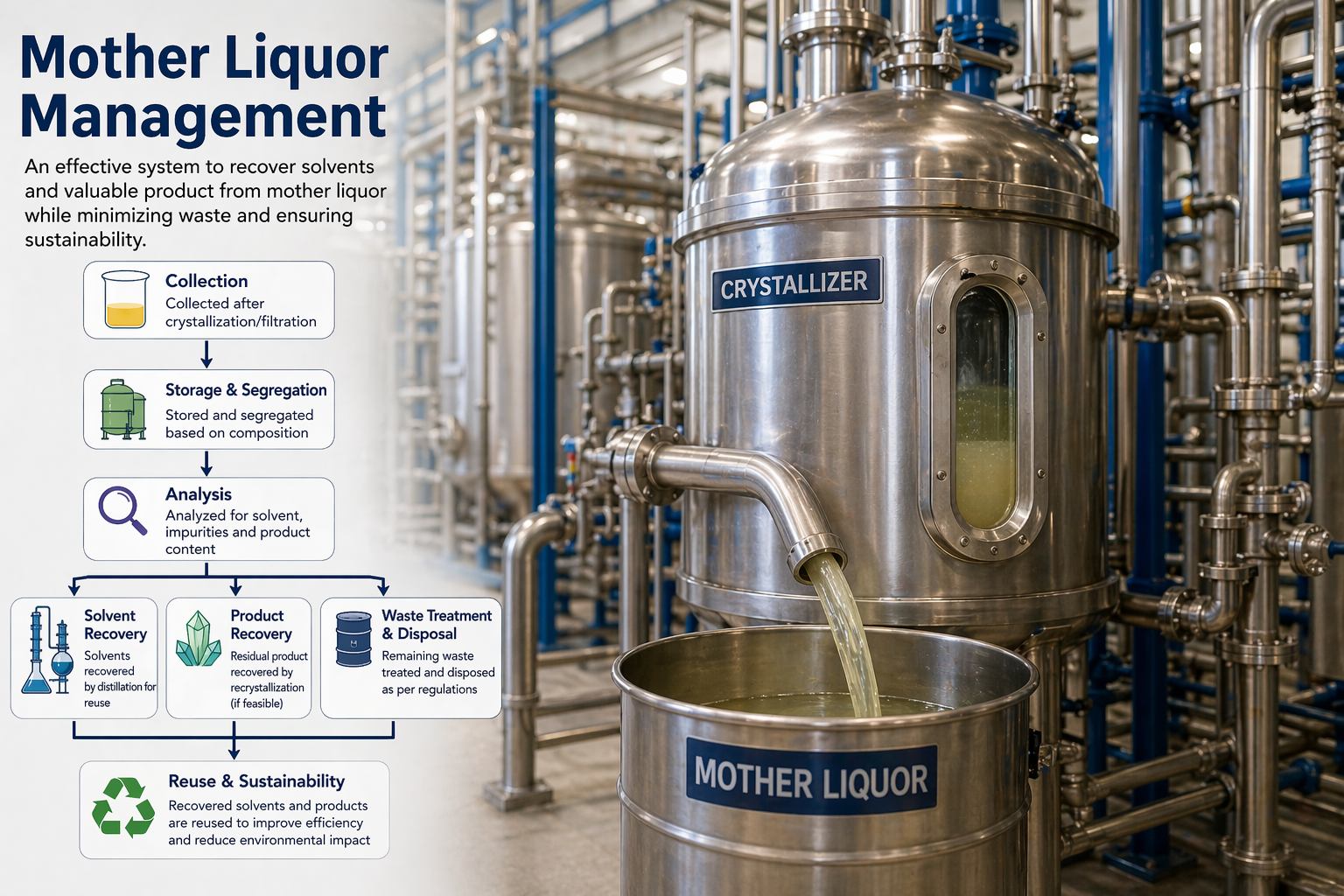
What is Mother Liquor?
Mother liquor is the liquid that remains after crystallization and separation of solid products. It typically contains:
- Residual solvents
- Dissolved impurities
- Unreacted raw materials
- Trace amounts of desired product
Mother liquor is not just waste—it is a valuable stream that can be processed further to recover solvents and useful materials.
Mother liquor management is essential for improving process efficiency, reducing waste, and optimizing resource utilization in pharmaceutical industries. Since mother liquor contains a mixture of solvents, impurities, and residual product, improper handling can lead to significant material loss and environmental concerns. By implementing effective mother liquor management strategies, industries can convert what is often considered waste into a valuable resource, thereby improving overall process economics and sustainability.
In modern pharmaceutical manufacturing, where cost control and regulatory compliance are critical, mother liquor management plays a strategic role. It supports continuous production by ensuring that valuable materials are recovered and reused efficiently. Additionally, it helps maintain consistency in operations by reducing variability in raw material usage and waste generation.
Importance of Mother Liquor Management
1. Cost Reduction
Mother liquor often contains valuable solvents and traces of the desired product that can be recovered and reused. Efficient mother liquor management allows industries to extract these materials, significantly reducing the need for fresh raw materials.
Over time, this leads to substantial cost savings, especially in large-scale production where solvent consumption is high. The recovery of even small percentages of product from mother liquor can contribute to improved profitability and better resource utilization.
2. Waste Minimization
Improper handling of mother liquor can result in increased hazardous waste generation, which requires costly treatment and disposal. Effective mother liquor management minimizes waste by recovering reusable components and reducing the volume of material sent for disposal.
This not only lowers disposal costs but also reduces the environmental burden associated with pharmaceutical manufacturing. A well-managed system ensures that waste generation is kept to a minimum while maximizing recovery efficiency.
3. Environmental Compliance
Pharmaceutical industries are subject to strict environmental regulations regarding waste management and emissions. Mother liquor streams, if not handled properly, can contribute to pollution and regulatory violations.
Implementing proper mother liquor management practices helps companies comply with pollution control norms and environmental guidelines. It also demonstrates a commitment to sustainable manufacturing and responsible resource management, which is increasingly important for regulatory approvals and corporate reputation.
4. Improved Yield
Mother liquor often contains residual amounts of the desired product that were not crystallized or separated during the initial process. Recovering this product through additional processing steps such as recrystallization or extraction can significantly improve overall yield.
Higher yield means better efficiency of raw material usage and increased production output without additional input costs. This is particularly important in pharmaceutical manufacturing, where product value is high and even small yield improvements can have a major financial impact.
5. Resource Optimization
Mother liquor management promotes efficient use of resources by ensuring that solvents and materials are reused wherever possible. Instead of treating mother liquor as waste, it is processed and reintegrated into the production cycle.
This reduces dependency on fresh raw materials, conserves natural resources, and supports a circular approach to manufacturing. Resource optimization also contributes to long-term sustainability and operational efficiency.
6. Process Stability and Consistency
Proper mother liquor management helps maintain stable process conditions by controlling the composition of recycled streams. When solvents and materials are recovered and reused in a controlled manner, it reduces variability in the manufacturing process.
This leads to consistent product quality, fewer process deviations, and improved overall reliability of operations.
Composition of Mother Liquor
The composition of mother liquor depends on the process and materials used. Typically, it includes:
- Organic solvents (ethanol, methanol, etc.)
- Dissolved API or intermediates
- Impurities and by-products
- Water or moisture
Understanding this composition is essential for designing effective mother liquor management strategies.
Sources of Mother Liquor in Pharma
Mother liquor is generated in several stages:
- Crystallization processes
- Filtration and centrifugation
- Washing of crystals
- Recrystallization steps
Each source may have different compositions, requiring tailored management approaches.
Mother Liquor Management Process
An effective mother liquor management system is essential for maximizing recovery, minimizing waste, and improving overall process efficiency in pharmaceutical manufacturing. Mother liquor, which remains after crystallization and separation, contains valuable solvents, impurities, and traces of the desired product. Instead of treating it as waste, a well-designed mother liquor management process focuses on systematic handling, analysis, recovery, and safe disposal.
A structured approach ensures that valuable components are recovered efficiently while maintaining compliance with environmental and regulatory standards. Below is a detailed explanation of each step involved in the mother liquor management process:
1. Collection of Mother Liquor
The first step in mother liquor management is the proper collection of the liquid stream after crystallization, filtration, or centrifugation.
Key Considerations:
- Use dedicated pipelines or containers to avoid contamination
- Prevent mixing with other process streams
- Ensure proper labeling for identification
Importance:
Efficient collection prevents loss of valuable materials and ensures that the mother liquor can be processed further without quality issues.
2. Storage and Segregation
Once collected, the mother liquor must be stored under controlled conditions and segregated based on its composition.
Segregation Criteria:
- Type of solvent (alcohols, hydrocarbons, etc.)
- Level of impurities
- Process origin
Best Practices:
- Use corrosion-resistant storage tanks
- Maintain proper temperature and pressure conditions
- Clearly label storage units
Importance:
Segregation improves recovery efficiency by avoiding complex mixtures that are difficult to separate.
3. Analysis of Composition
Before processing, it is essential to analyze the composition of the mother liquor to determine the most suitable recovery method.
Parameters Analyzed:
- Solvent type and concentration
- Presence of impurities and by-products
- Residual product content
- Moisture content
Analytical Techniques:
- Gas Chromatography (GC)
- High-Performance Liquid Chromatography (HPLC)
- Karl Fischer titration for moisture
Importance:
Accurate analysis helps in selecting the most efficient and cost-effective recovery strategy.
4. Recovery of Solvents
Solvent recovery is a major objective of mother liquor management, as solvents represent a significant cost in pharmaceutical processes.
Common Methods:
- Distillation (most widely used)
- Vacuum distillation for heat-sensitive solvents
- Membrane separation for energy-efficient recovery
Key Considerations:
- Maintain optimal temperature and pressure
- Avoid thermal degradation of solvents
- Ensure proper condensation and collection
Importance:
Efficient solvent recovery reduces raw material costs and supports sustainable manufacturing.
5. Recovery of Product (If Feasible)
In many cases, mother liquor contains residual amounts of the desired product that can be recovered.
Recovery Techniques:
- Recrystallization
- Evaporation and concentration
- Liquid-liquid extraction
Economic Consideration:
- Evaluate cost vs. benefit of recovery
- Recover only if economically viable
Importance:
Recovering product increases overall yield and improves process efficiency.
6. Treatment and Disposal of Remaining Waste
After recovering solvents and useful materials, the remaining waste must be treated and disposed of safely.
Treatment Methods:
- Biological treatment
- Chemical treatment
- Incineration (for hazardous waste)
Regulatory Compliance:
- Follow environmental and safety guidelines
- Ensure proper documentation and reporting
Importance:
Safe disposal prevents environmental contamination and ensures compliance with regulatory standards.
Process Integration and Optimization
For maximum efficiency, the mother liquor management process should be integrated with other systems such as solvent recovery units and waste treatment facilities.
Optimization Strategies:
- Use automated monitoring systems
- Implement heat integration to reduce energy consumption
- Continuously evaluate process performance
Benefits:
- Higher recovery rates
- Lower operational costs
- Improved sustainability
Recovery Methods in Mother Liquor Management
Recovery methods in mother liquor management are essential for extracting valuable solvents and residual products from the liquid stream generated after crystallization. An efficient recovery strategy not only improves process economics but also reduces waste generation and supports sustainable manufacturing. The selection of an appropriate recovery method depends on factors such as solvent type, impurity profile, product concentration, and economic feasibility.
Below are the major recovery methods used in mother liquor management, explained in detail:
1. Solvent Recovery
Solvent recovery is the most important step in mother liquor management, as solvents account for a significant portion of process costs. The primary objective is to separate and purify solvents so they can be reused in the production cycle.
Common Technique: Distillation
Distillation is widely used because it separates components based on differences in boiling points.
Types of Distillation Used:
- Simple distillation
- Fractional distillation
- Vacuum distillation (for heat-sensitive solvents)
Key Considerations:
- Maintain optimal temperature and pressure
- Ensure efficient condensation
- Avoid thermal degradation
Benefits:
- Reduces raw material cost
- Improves sustainability
- Minimizes solvent waste
2. Recrystallization
Recrystallization is used to recover residual product dissolved in the mother liquor. This method is particularly useful when the concentration of the product is significant enough to justify recovery.
Process:
- Concentrate the mother liquor
- Adjust temperature or solvent composition
- Induce crystal formation
Advantages:
- Improves overall product yield
- Produces high-purity crystals
Limitations:
- May require additional solvent
- Not always economical for very low concentrations
3. Evaporation
Evaporation is a simple and effective method used to remove solvents from mother liquor, leaving behind concentrated residues.
Process:
- Apply heat to vaporize the solvent
- Collect vapor for possible condensation
- Retain concentrated solids or slurry
Types:
- Atmospheric evaporation
- Vacuum evaporation (for temperature-sensitive materials)
Advantages:
- Simple operation
- Useful for concentration
Limitations:
- High energy consumption
- Risk of thermal degradation
4. Liquid-Liquid Extraction
Liquid-liquid extraction (LLE) is used to separate components based on their solubility in two immiscible liquids.
Process:
- Add a suitable extracting solvent
- Allow components to distribute between phases
- Separate layers
Applications:
- Recovery of specific compounds
- Removal of impurities
Advantages:
- Effective for selective separation
- Can handle complex mixtures
Limitations:
- Requires additional solvent
- Needs careful solvent selection
5. Membrane Technology
Membrane-based separation is an advanced and energy-efficient method used in modern mother liquor management systems.
Types of Membrane Processes:
- Nanofiltration
- Reverse osmosis
- Pervaporation
Working Principle:
Semi-permeable membranes allow selective passage of certain components while retaining others.
Advantages:
- Low energy consumption
- Environmentally friendly
- Continuous operation
Limitations:
- High initial cost
- Membrane fouling issues
Selection of Recovery Method
Choosing the right recovery method depends on:
- Composition of mother liquor
- Type of solvent and impurities
- Product value and concentration
- Energy and cost considerations
Often, a combination of methods (e.g., distillation + recrystallization) is used to achieve maximum recovery efficiency.
Challenges in Mother Liquor Management
Mother liquor management in pharmaceutical manufacturing is a complex and resource-intensive process. The presence of multiple components, varying compositions, and operational constraints makes efficient recovery challenging. Understanding these challenges is essential for designing effective systems and improving overall process performance.
1. Complex Composition
Mother liquor typically contains a mixture of solvents, impurities, unreacted materials, and traces of the desired product. This complex composition makes separation and recovery difficult.
Impact:
- Requires multi-stage separation techniques
- Increases process complexity
- May reduce recovery efficiency
Challenge:
Some components may form azeotropes or interact chemically, making standard separation methods less effective.
2. Low Product Concentration
In many cases, the concentration of the desired product in mother liquor is very low.
Impact:
- Recovery may not always be economically viable
- Requires additional processing steps like concentration or extraction
Challenge:
Industries must balance the cost of recovery with the value of the recovered product to determine feasibility.
3. Energy Consumption
Recovery processes such as distillation and evaporation require significant energy input, especially when dealing with large volumes of solvent.
Impact:
- High operational costs
- Increased carbon footprint
Challenge:
Energy-intensive operations can reduce the overall efficiency and sustainability of the process if not optimized properly.
4. Handling Hazardous Materials
Mother liquor may contain toxic, flammable, or volatile substances, posing safety risks.
Impact:
- Requires strict safety measures
- Increases handling and storage complexity
Challenge:
Ensuring safe handling, storage, and processing while maintaining efficiency is a major concern in pharmaceutical plants.
5. Variability in Composition
The composition of mother liquor can vary from batch to batch depending on process conditions and raw materials.
Impact:
- Makes process standardization difficult
- Requires continuous monitoring and adjustments
Best Practices for Mother Liquor Management
To overcome these challenges and maximize recovery efficiency, pharmaceutical industries must adopt well-defined best practices. These practices ensure better control, improved recovery rates, and sustainable operations.
1. Segregation of Streams
Proper segregation of mother liquor streams based on composition is crucial for efficient recovery.
Best Practices:
- Separate streams based on solvent type and impurity level
- Avoid mixing incompatible solvents
- Use dedicated storage systems
Benefits:
- Simplifies separation process
- Improves recovery efficiency
- Reduces energy consumption
2. Process Optimization
Optimizing operating conditions is essential for improving recovery performance.
Key Parameters:
- Temperature
- Pressure
- Flow rate
- Recovery method selection
Best Practices:
- Use vacuum conditions for heat-sensitive materials
- Adjust parameters based on feed composition
- Continuously evaluate system performance
Benefits:
- Higher recovery yield
- Reduced energy usage
- Improved solvent purity
3. Regular Monitoring
Continuous monitoring of mother liquor composition ensures better process control and consistency.
Best Practices:
- Conduct regular analytical testing (e.g., GC, HPLC)
- Monitor solvent concentration and impurities
- Maintain proper documentation
Benefits:
- Early detection of process deviations
- Improved decision-making
- Consistent product quality
4. Integration with Solvent Recovery Systems
Combining mother liquor management with solvent recovery systems enhances overall efficiency.
Approach:
- Link mother liquor streams to distillation units
- Reuse recovered solvents in the process
Benefits:
- Maximizes resource utilization
- Reduces raw material consumption
- Improves process sustainability
5. Use of Advanced Technologies
Modern technologies can significantly improve the efficiency of mother liquor management.
Technologies Used:
- Membrane separation systems
- Automated control systems (PLC/SCADA)
- Energy-efficient distillation units
Benefits:
- Reduced energy consumption
- Higher recovery efficiency
- Better process control
6. Safety and Compliance Management
Ensuring safety and regulatory compliance is essential when handling mother liquor streams.
Best Practices:
- Use explosion-proof equipment
- Ensure proper ventilation
- Follow standard operating procedures (SOPs)
- Train personnel regularly
Benefits:
- Safe working environment
- Compliance with regulations
- Reduced risk of accidents
Environmental Impact of Mother Liquor
Proper mother liquor management reduces:
- Hazardous waste
- Environmental pollution
- Resource wastage
It supports sustainable manufacturing practices in pharma industries.
Applications of Mother Liquor Management
Mother liquor management is widely used in:
- API manufacturing
- Chemical processing
- Fine chemical industries
Process Optimization Strategies
To improve mother liquor management:
- Use multi-stage recovery systems
- Optimize crystallization conditions
- Implement heat integration
- Automate monitoring systems
Future Trends in Mother Liquor Management
- Green chemistry approaches
- Energy-efficient recovery systems
- AI-based process optimization
- Zero liquid discharge systems
FAQs
1. What is mother liquor in pharmaceuticals?
Mother liquor is the liquid remaining after crystallization that contains solvents, impurities, and residual product.
2. Why is mother liquor management important?
It helps reduce waste, recover valuable materials, and improve process efficiency.
3. How is solvent recovered from mother liquor?
Mainly through distillation and other separation techniques.
4. What are the challenges in mother liquor management?
Complex composition, low product concentration, and high energy consumption.
5. Can mother liquor be reused?
Yes, after proper treatment and recovery processes.
1 thought on “Mother Liquor Management: 2026 Complete Guide to Process, Challenges & Solutions”