Pediatric dose calculation is one of the most important skills in nursing, pharmacy, and clinical practice. Unlike adult dosing, pediatric dose calculation requires extra precision because children are more sensitive to medications and dosage errors. Even a small mistake in pediatric dose calculation can lead to serious complications, toxicity, or ineffective treatment.
Healthcare professionals use pediatric dose calculation to determine the correct medication dose based on factors such as body weight, age, and body surface area. Since children vary greatly in size and metabolism, pediatric dose calculation must always be performed carefully and accurately.
Many students and healthcare professionals find pediatric dose calculation difficult because it involves formulas, unit conversions, and weight-based dosing methods. However, with proper understanding and regular practice, pediatric dose calculation becomes much easier.
This complete 2026 guide explains the in a simple step-by-step format with formulas, tricks, examples, common mistakes, MCQs, and practical tips. By the end of this article, you will understand pediatric dose calculation confidently and accurately.
What is Pediatric Dose Calculation?
Pediatric dose calculation is the process of calculating the correct medication dose for infants, children, and adolescents. Since children are smaller than adults and have different physiological responses, medication doses must be adjusted carefully.
Pediatric dose calculation is commonly based on:
- Body weight (kg)
- Age
- Body surface area (BSA)
Accurate calculation ensures safe medication administration and effective treatment outcomes.
Why Pediatric Dose Calculation is Important
Pediatric dose calculation is one of the most critical responsibilities in healthcare because their process of IV fluid calculation for children require highly accurate medication dosing. Unlike adults, children have developing organs, different metabolic rates, and lower body weight, which make them more sensitive to medications. Even a small mistake in pediatric dose calculation can result in serious health complications. Therefore, healthcare professionals must understand the importance of pediatric dose calculation to ensure safe and effective treatment.
Below are the major reasons why pediatric dose calculation is important in clinical practice.
1. Prevents Overdose
One of the most important reasons for accurate pediatric dose calculation is the prevention of overdose. Children are highly sensitive to medicines because their liver and kidneys are not fully developed. These organs are responsible for metabolizing and eliminating drugs from the body. If the pediatric dose calculation is incorrect, the medication may accumulate in the body and cause toxicity.
Why overdose is dangerous in children:
- Higher risk of drug toxicity
- Organ damage
- Breathing problems
- Seizures in severe cases
Example:
If a child weighing 10 kg accidentally receives a dose meant for a 30 kg child, the medication concentration in the body becomes dangerously high.
Clinical Importance:
Accurate dose calculation ensures that the medicine remains within the therapeutic range and does not reach toxic levels.
2. Ensures Effective Treatment
Correct calculation is essential for achieving the desired therapeutic effect. If the dose is too low, the medicine may not work properly, leading to treatment failure.
Why underdosing is harmful:
- Infection may not be controlled
- Symptoms may persist
- Disease progression can occur
Example:
An insufficient antibiotic dose may fail to eliminate bacteria completely, increasing the risk of antibiotic resistance.
Clinical Importance:
Proper dose calculation helps ensure that the child receives an effective dose for successful treatment and faster recovery.
3. Improves Patient Safety
Patient safety is one of the primary goals of healthcare, and pediatric dose calculation plays a major role in preventing medication errors. Since children cannot always communicate symptoms clearly, medication mistakes can become more dangerous.
Common medication errors in pediatrics:
- Wrong dose calculation
- Incorrect unit conversion
- Decimal point mistakes
- Wrong concentration administration
Why safety is critical in pediatrics:
Children have smaller body sizes and lower tolerance levels compared to adults. Even small dosing errors can significantly affect their health.
Clinical Importance:
Accurate pediatric dose calculation minimizes medication-related risks and improves overall patient safety in hospitals and clinics.
4. Essential in Emergency Care
Pediatric dose calculation becomes even more important during emergency situations and intensive care treatment. In emergencies, healthcare professionals often need to administer medications quickly and accurately.
Examples of emergency situations:
- Seizures
- Severe dehydration
- Cardiac arrest
- Shock management
Why accuracy matters in emergencies:
- Delayed or incorrect dosing can become life-threatening
- Emergency drugs often have narrow safety margins
Clinical Importance:
Correct pediatric dose calculation ensures rapid and safe treatment during critical situations, especially in pediatric ICU and emergency departments.
5. Supports Accurate IV Medication Administration
Many pediatric medications are administered intravenously, where dosing accuracy is extremely important. IV medications act rapidly, so any mistake in dose calculation can have immediate effects.
Potential complications of incorrect IV dosing:
- Fluid overload
- Drug toxicity
- Electrolyte imbalance
Clinical Importance:
Proper calculation ensures safe IV infusion rates and accurate medication delivery.
6. Reduces Risk of Long-Term Complications
Incorrect calculation may not only cause immediate side effects but can also lead to long-term health complications.
Possible long-term effects include:
- Kidney damage
- Liver toxicity
- Developmental issues
Clinical Importance:
Accurate calculation protects children from both short-term and long-term medication-related complications.
7. Builds Professional Confidence
Healthcare professionals who are skilled in pediatric dose calculation perform clinical tasks more confidently and accurately.
Benefits include:
- Better clinical decision-making
- Reduced stress during emergencies
- Improved patient trust
Clinical Importance:
Strong pediatric dose calculation skills improve professional competence and quality of patient care.
Basic Pediatric Dose Calculation Formula
The most common pediatric dose calculation method is weight-based dosing.
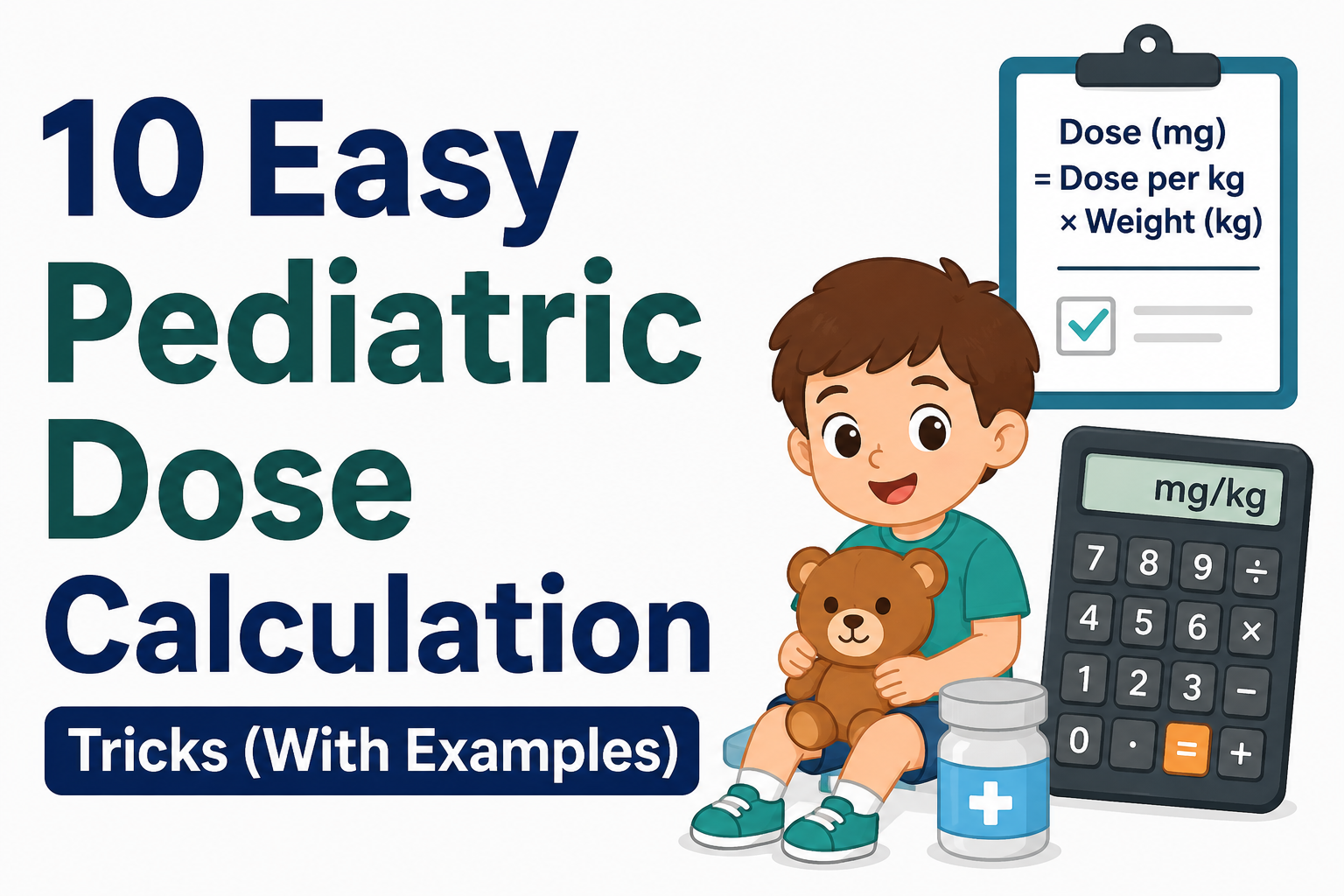
Pediatric Dose=Dose per kg×Body Weight (kg)\text{Pediatric Dose} = \text{Dose per kg} \times \text{Body Weight (kg)}
Example of Pediatric Dose Calculation
A child weighs 20 kg. Prescribed dose = 10 mg/kg.
Solution:
10 × 20 = 200 mg
Therefore, the pediatric dose calculation gives 200 mg.
Methods of Pediatric Dose Calculation
Several methods are used in pediatric dose calculation.
1. Weight-Based Pediatric Dose Calculation
This is the most accurate method.
Formula:
Dose=Weight (kg)×Dose per kg\text{Dose} = \text{Weight (kg)} \times \text{Dose per kg}
Example:
Weight = 15 kg
Dose = 5 mg/kg
Solution:
15 × 5 = 75 mg
2. Body Surface Area (BSA) Method
BSA-based pediatric dose calculation is commonly used for chemotherapy drugs.
Formula:
Child Dose=Child BSA1.73×Adult Dose\text{Child Dose} = \frac{\text{Child BSA}}{1.73} \times \text{Adult Dose}
3. Young’s Rule
Used for age-based pediatric dose calculation.
Formula:
Child Dose=AgeAge+12×Adult Dose\text{Child Dose} = \frac{\text{Age}}{\text{Age}+12} \times \text{Adult Dose}
4. Clark’s Rule
Based on body weight in pounds.
Formula:
Child Dose=Weight in lbs150×Adult Dose\text{Child Dose} = \frac{\text{Weight in lbs}}{150} \times \text{Adult Dose}
10 Easy Pediatric Dose Calculation Tricks
Pediatric dose calculation can sometimes feel complicated because children require highly accurate medication dosing. However, by following a few simple tricks and best practices, healthcare professionals and students can improve both speed and accuracy in pediatric dose calculation. These tricks help reduce medication errors, improve confidence, and ensure safe patient care.
Below are 10 easy pediatric dose calculation tricks explained in detail.
1. Always Convert Weight into Kilograms
One of the most important rules in pediatric dose calculation is converting body weight into kilograms. Most pediatric medications are prescribed in mg/kg, so using pounds directly can lead to incorrect dosing.
Formula:
1 kg=2.2 lbs1\ \text{kg} = 2.2\ \text{lbs}
Example:
44 lbs÷2.2=20 kg44\ \text{lbs} \div 2.2 = 20\ \text{kg}
Why it matters:
Using pounds instead of kilograms can result in overdose or underdose.
Best Practice:
Always confirm whether weight is given in pounds or kilograms before starting pediatric dose calculation.
2. Memorize Common Formulas
Knowing important formulas improves pediatric dose calculation speed and accuracy. Healthcare professionals who memorize formulas can solve calculations faster, especially during emergencies.
Common Formula:
Pediatric Dose=Dose per kg×Body Weight (kg)\text{Pediatric Dose} = \text{Dose per kg} \times \text{Body Weight (kg)}
Why it helps:
- Saves time
- Reduces confusion
- Improves confidence
Best Practice:
Practice formulas daily until they become easy to remember.
3. Double-Check Units
Unit mistakes are very common in pediatric dose calculation and can lead to dangerous medication errors.
Always verify:
- mg
- mL
- kg
- mcg
Why it matters:
Confusing mg with mcg can result in a 1000-times dosing error.
Best Practice:
Write units clearly beside every number during pediatric dose calculation.
4. Write Formula First
Before solving any problem, always write the formula first. This reduces confusion and improves accuracy.
Why it helps:
- Keeps calculations organized
- Prevents skipping steps
- Improves exam performance
Example:
If calculating dose based on weight, first write:
Dose=Weight×Dose per kg\text{Dose} = \text{Weight} \times \text{Dose per kg}
Best Practice:
Never solve directly without writing the formula.
5. Use Step-by-Step Method
Mental calculations increase the risk of errors. A step-by-step method improves pediatric dose calculation accuracy.
Recommended steps:
- Identify given data
- Convert units if needed
- Write formula
- Substitute values
- Solve carefully
Why it helps:
- Reduces mistakes
- Makes calculations easier
- Improves clarity
Best Practice:
Write every step clearly, especially during exams and clinical practice.
6. Practice Daily
Regular practice is the key to mastering pediatric dose calculation. The more problems you solve, the more confident and accurate you become.
Benefits of daily practice:
- Faster calculations
- Better understanding
- Reduced anxiety during exams
Best Practice:
Practice different types of pediatric dose calculation questions every day.
7. Avoid Decimal Errors
Decimal mistakes are extremely dangerous in pediatric dose calculation because children require small doses.
Examples of decimal errors:
- 0.5 mg written as 5 mg
- 1.0 mg mistaken as 10 mg
Why it matters:
Even a small decimal error can cause serious overdose or toxicity.
Safety Tips:
- Always use leading zero (0.5)
- Avoid trailing zero (5.0) unless necessary
Best Practice:
Double-check decimal placement before finalizing the answer.
8. Confirm Safe Dose Range
Even if the calculation appears correct, always verify whether the dose is within the recommended safe range.
Why it matters:
Some medications have maximum pediatric dose limits.
Example:
A calculated dose may exceed the safe pediatric limit even if the formula is correct.
Best Practice:
Always compare your pediatric dose calculation with standard dosing guidelines.
9. Recalculate if Answer Looks Wrong
Clinical judgment is very important in pediatric dose calculation. If the final answer seems too high or too low, recalculate immediately.
Warning signs:
- Extremely high dose
- Very small or unrealistic value
- Sudden change from normal dosing range
Why it matters:
Human errors are common during busy clinical situations.
Best Practice:
Never ignore suspicious results.
10. Use Clinical Judgment
Pediatric dose calculation should always make clinical sense. Calculations should be evaluated along with patient condition, age, and diagnosis.
Why it matters:
Mathematically correct answers may still be clinically inappropriate.
Example:
A dose suitable for an older child may not be safe for a newborn.
Best Practice:
Combine pediatric dose calculation skills with clinical knowledge and patient assessment.
Step-by-Step Pediatric Dose Calculation Examples
Example 1: Weight-Based Calculation
Child weight = 25 kg
Dose = 8 mg/kg
Solution:
25 × 8 = 200 mg
Example 2: Young’s Rule
Age = 6 years
Adult dose = 300 mg
Solution:
6 ÷ (6 + 12) × 300
= 6 ÷ 18 × 300
= 100 mg
Example 3: Clark’s Rule
Weight = 50 lbs
Adult dose = 400 mg
Solution:
50 ÷ 150 × 400
= 133 mg
Tips to Improve Pediatric Dose Calculation Accuracy
Clinical Importance of Pediatric Dose Calculation
Pediatric dose calculation plays a vital role in patient safety and treatment success.
Importance includes:
- Prevents overdose
- Ensures proper therapy
- Reduces medication errors
- Improves clinical outcomes
In pediatric care, accurate pediatric dose calculation can be life-saving.
Advanced Pediatric Dose Calculation
Advanced pediatric dose calculation may involve:
- IV infusion dosing
- Chemotherapy calculations
- BSA methods
- Neonatal dosing
These require extra precision.
MCQs on Pediatric Dose Calculation
1. A child weighs 10 kg. Dose = 5 mg/kg. What is the dose?
A. 25 mg
B. 50 mg
C. 75 mg
D. 100 mg
Answer:
50 mg
2. 22 lbs equals how many kilograms?
A. 5 kg
B. 8 kg
C. 10 kg
D. 12 kg
Answer:
10 kg
3. Which method uses body surface area?
A. Clark’s Rule
B. Young’s Rule
C. BSA Method
D. Age Method
Answer:
BSA Method
Practice Questions
- Child weight = 15 kg, dose = 10 mg/kg
- Adult dose = 500 mg, age = 5 years
- Weight = 60 lbs, adult dose = 300 mg
Conclusion
Pediatric dose calculation is a critical skill in healthcare that ensures safe and accurate medication administration for children. Since pediatric patients are more sensitive to medications than adults, even a small mistake in pediatric dose calculation can lead to serious complications. Therefore, healthcare professionals must understand formulas, dosing methods, and unit conversions properly.
By practicing regularly, using the correct formulas, and avoiding common mistakes, students and healthcare professionals can master pediatric dose calculation with confidence. Step-by-step problem-solving methods, double-checking calculations, and verifying safe dose ranges can significantly improve accuracy and patient safety.
In modern healthcare, pediatric dose calculation remains one of the most important responsibilities in nursing, pharmacy, and pediatric medicine. Accurate pediatric dose calculation not only improves clinical performance but also ensures better treatment outcomes and safer patient care.
FAQs
1. What is pediatric dose calculation?
It is the process of calculating medication doses for children.
2. Why is pediatric dose calculation important?
To ensure safe and effective medication administration.
3. What is the most accurate method?
Weight-based pediatric dose calculation.
4. Why convert pounds into kilograms?
Most pediatric dose calculation formulas use kilograms.
5. How can medication errors be prevented?
By double-checking formulas and calculations.
Conclusion
Pediatric dose calculation is a critical skill in healthcare that ensures safe and accurate medication administration for children. Since pediatric patients are more sensitive to medications than adults, even a small mistake in pediatric dose calculation can lead to serious complications. Therefore, healthcare professionals must understand formulas, dosing methods, and unit conversions properly.
By practicing regularly, using the correct formulas, and avoiding common mistakes, students and healthcare professionals can master pediatric dose calculation with confidence. Step-by-step problem-solving methods, double-checking calculations, and verifying safe dose ranges can significantly improve accuracy and patient safety.
In modern healthcare, calculation remains one of the most important responsibilities in nursing, pharmacy, and pediatric medicine. Accurate pediatric dose calculation not only improves clinical performance but also ensures better treatment outcomes and safer patient care.