Reprocessing & Rework in Pharmaceuticals is a critical topic in pharmaceutical manufacturing that directly impacts product quality, regulatory compliance, and cost efficiency. Every pharmaceutical company faces situations where a batch does not meet predefined specifications, and in such cases, Reprocessing & Rework in Pharmaceuticals becomes an essential consideration.
Understanding Reprocessing & Rework in Pharmaceuticals is important for process engineers, QA professionals, and production teams because improper handling can lead to regulatory observations, product recalls, or even patient safety risks.
In this complete 2026 guide, we will explore every aspect of Reprocessing & Rework in Pharmaceuticals including definitions, differences, regulatory expectations, risks, procedures, validation requirements, and real-world examples.
What is Reprocessing in Pharmaceuticals?
Reprocessing in pharmaceuticals refers to repeating a specific step of the approved manufacturing process when a batch fails to meet quality specifications. Reprocessing & Rework in Pharmaceuticals considers reprocessing as the safer and more acceptable option because it follows already validated steps.
In Reprocessing & Rework in Pharmaceuticals, reprocessing is allowed only when the deviation is minor and scientifically justified.
Key Characteristics of Reprocessing
- Uses the same validated process
- No major modification in manufacturing steps
- Requires QA approval
- Must be documented properly
Example of Reprocessing
A tablet batch fails moisture content during drying. The batch is reprocessed by repeating the drying cycle under controlled conditions. This is a standard case of Reprocessing & Rework in Pharmaceuticals.
What is Rework in Pharmaceuticals?
Rework in pharmaceuticals involves applying a process that is not part of the original approved manufacturing process to make the batch manufacturing meet specifications. In Reprocessing & Rework in Pharmaceuticals, rework is considered high risk.
Reprocessing & Rework in Pharmaceuticals guidelines clearly state that rework should be avoided unless absolutely necessary.
Key Characteristics of Rework
- Involves additional or modified steps
- Requires strong scientific justification
- Needs regulatory approval
- Higher impact on product quality
Example of Rework
If a batch fails assay, adding additional API to adjust potency is considered rework. This is a classic example under Reprocessing & Rework in Pharmaceuticals.
Difference Between Reprocessing & Rework in Pharmaceuticals
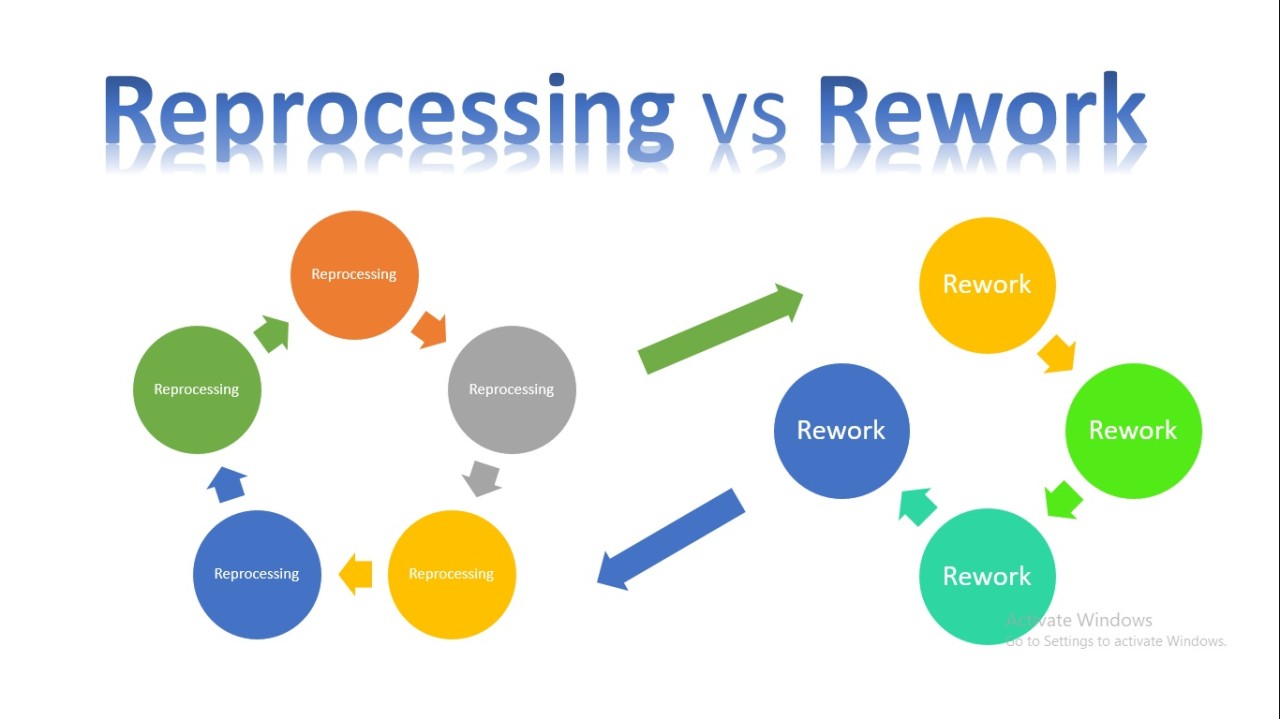
Understanding the difference between Reprocessing & Rework in Pharmaceuticals is extremely important for maintaining GMP compliance, product quality, and regulatory acceptance. Although both processes are used to handle non-conforming batches, they differ significantly in terms of risk, regulatory expectations, validation requirements, and impact on product quality.
1. Definition and Concept
Reprocessing in Pharmaceuticals refers to repeating a part of the original approved manufacturing process when a batch fails to meet specifications. It does not introduce any new step and remains within validated process parameters.
On the other hand, Rework in Pharmaceuticals involves applying a new or modified process step that was not part of the original manufacturing process to make the batch meet specifications.
In simple terms:
- Reprocessing = Repeat the same step
- Rework = Change or add a new step
2. Nature of Process
In Reprocessing & Rework in Pharmaceuticals, the nature of the process is a key differentiator:
- Reprocessing follows the same process flow, equipment, and parameters.
- Rework introduces changes such as additional blending, regranulation, or API addition.
Because reprocessing stays within the original design space, it is considered more controlled and predictable.
3. Regulatory Acceptance
Regulatory agencies such as US FDA, WHO, and EU GMP are more comfortable with reprocessing than rework.
- Reprocessing is generally acceptable if predefined in SOPs and supported by validation data.
- Rework requires strong scientific justification and may need prior regulatory approval.
Many regulatory observations arise due to improper handling of rework, making it a critical compliance risk.
4. Risk Level
Risk is one of the biggest differences in Reprocessing & Rework in Pharmaceuticals:
- Reprocessing → Low risk
- Rework → High risk
Rework can lead to:
- Impurity formation
- API degradation
- Non-uniformity
Whereas reprocessing typically has minimal impact when done correctly.
5. Validation Requirements
Validation plays a crucial role:
- Reprocessing is usually covered under existing process validation.
- Rework requires:
- New validation studies
- Re-validation of process
- Additional analytical testing
This makes rework more complex and resource-intensive.
6. Impact on Product Quality
In Reprocessing & Rework in Pharmaceuticals, product quality impact differs significantly:
- Reprocessing has minimal impact if performed within limits.
- Rework may alter:
- Dissolution profile
- Stability
- Content uniformity
Because of this, rework requires extensive evaluation before batch release.
7. Documentation Requirements
Both require documentation, but the level differs:
Reprocessing Documentation:
- Deviation report
- Investigation
- QA approval
- Batch record update
Rework Documentation:
- Detailed rework protocol
- Change control
- Risk assessment
- Regulatory justification
- Stability data
Rework documentation is much more extensive due to higher risk.
8. Examples
Reprocessing Example:
A batch fails moisture content → Re-drying is performed
Same process step → Reprocessing
Rework Example:
A batch fails assay → Additional API added
New step introduced → Rework
9. Frequency of Use
- Reprocessing can be used occasionally when scientifically justified
- Rework should be rare and avoided whenever possible
Frequent rework indicates poor process control and may attract regulatory concern.
10. Cost and Business Impact
From a business perspective:
- Reprocessing → Cost-effective, minimal delay
- Rework → Expensive, time-consuming, regulatory risk
Excessive rework can increase:
- Manufacturing cost
- Batch cycle time
- Risk of rejection
11. GMP Compliance Perspective
From a GMP standpoint:
- Reprocessing is acceptable when predefined and validated
- Rework must be:
- Exceptional
- Justified
- Controlled
Regulators expect companies to minimize rework and focus on right-first-time manufacturing.
Regulatory Guidelines for Reprocessing & Rework in Pharmaceuticals
Reprocessing & Rework in Pharmaceuticals is strictly regulated by global authorities like US FDA, WHO, and EU GMP.
Key GMP Requirements
- Written SOPs must define Reprocessing & Rework in Pharmaceuticals procedures
- Scientific justification is mandatory
- QA approval is required before execution
- Full documentation must be maintained
- Stability impact must be evaluated
Failure to follow proper Reprocessing & Rework in Pharmaceuticals guidelines can result in regulatory actions.
When is Reprocessing Allowed?
Reprocessing & Rework in Pharmaceuticals allows reprocessing under controlled conditions:
- Minor and reversible deviation
- No impact on critical quality attributes
- Process remains within validated limits
- Approved by QA
When is Rework Allowed?
Reprocessing & Rework in Pharmaceuticals allows rework only in exceptional cases:
- No alternative solution available
- Strong scientific justification
- Product safety is not compromised
- Regulatory approval is obtained
Risks in Reprocessing & Rework in Pharmaceuticals
1. Quality Risks
Reprocessing & Rework in Pharmaceuticals may lead to:
- API degradation
- Impurity formation
- Change in dissolution profile
2. Compliance Risks
- GMP violations
- Warning letters
- Audit observations
3. Process Risks
- Equipment contamination
- Loss of traceability
4. Patient Safety Risks
Improper Reprocessing & Rework in Pharmaceuticals can impact patient safety due to reduced efficacy or toxicity.
Step-by-Step Procedure for Reprocessing
- Identify deviation
- Conduct investigation
- Perform risk assessment
- Get QA approval
- Execute reprocessing
- Perform testing
- Release batch
Reprocessing & Rework in Pharmaceuticals requires strict adherence to these steps.
Step-by-Step Procedure for Rework
- Identify failure
- Perform detailed investigation
- Develop rework protocol
- Risk assessment
- Regulatory approval
- Execute rework
- Full testing
- Stability study
Reprocessing & Rework in Pharmaceuticals emphasizes that rework must be controlled and justified.
Documentation in Reprocessing & Rework in Pharmaceuticals
Proper documentation includes:
- Deviation report
- Investigation report
- CAPA
- Change control
- Batch record updates
- Rework protocol
Documentation is a backbone of Reprocessing & Rework in Pharmaceuticals compliance.
Validation Considerations
Reprocessing
Covered under existing validation in Reprocessing & Rework in Pharmaceuticals.
Rework
Requires:
- New validation
- Process re-validation
- Analytical verification
Stability Impact
Reprocessing & Rework in Pharmaceuticals requires evaluation of:
- Shelf life
- Degradation profile
- Packaging compatibility
Stability studies are critical for ensuring product quality after reprocessing or rework.
Real-Life Case Studies
Case 1: Reprocessing
A granulation batch shows high moisture. Re-drying resolves the issue successfully. This is a compliant case of Reprocessing & Rework in Pharmaceuticals.
Case 2: Rework
A batch fails assay. API is added and re-blended. Additional testing and validation are required. This is a high-risk case under Reprocessing & Rework in Pharmaceuticals.
Best Practices
- Avoid rework whenever possible
- Strengthen process control
- Use PAT tools
- Train staff regularly
- Maintain documentation
Following best practices improves efficiency in Reprocessing & Rework in Pharmaceuticals.
Common Mistakes
- Lack of scientific justification
- Poor documentation
- Ignoring stability
- Unauthorized rework
Avoiding these mistakes is critical in Reprocessing & Rework in Pharmaceuticals.
Benefits of Reprocessing & Rework in Pharmaceuticals
- Reduces batch rejection
- Saves cost
- Improves yield
- Enhances operational efficiency
Conclusion
Reprocessing & Rework in Pharmaceuticals plays a crucial and unavoidable role in modern pharmaceutical manufacturing, where maintaining product quality, regulatory compliance, and cost efficiency is essential. In a highly regulated environment, even minor deviations can lead to batch failures, making it important for organizations to have well-defined strategies for handling such situations. This is where Reprocessing & Rework in Pharmaceuticals becomes a key operational and quality tool.
Reprocessing, being a repetition of an already validated step, is generally considered safe, controlled, and acceptable when performed within defined limits. It helps manufacturers recover batches without significantly affecting product quality or regulatory compliance. When supported by scientific justification, proper documentation, and QA approval, reprocessing can effectively reduce batch rejection rates and improve overall manufacturing efficiency.
On the other hand, rework is more complex and carries higher risk because it involves modifying or adding new process steps that were not originally validated. Due to its potential impact on product quality, stability, and safety, rework should always be treated as an exception rather than a routine practice. Regulatory authorities closely scrutinize rework activities, and improper handling can lead to serious compliance issues, including warning letters or product recalls.
A well-balanced approach to Reprocessing & Rework in Pharmaceuticals requires strong process understanding, robust quality systems, and strict adherence to GMP guidelines. Companies must focus on root cause analysis, effective CAPA implementation, and continuous process improvement to minimize the need for both reprocessing and rework. Investing in better process controls, real-time monitoring tools, and skilled personnel can significantly reduce the occurrence of deviations in the first place.
Ultimately, the goal of Reprocessing & Rework in Pharmaceuticals is not just batch recovery, but ensuring that every product released to the market meets the highest standards of safety, efficacy, and quality. Organizations that manage these processes effectively can achieve improved operational performance, reduced costs, and stronger regulatory confidence.
In conclusion, while Reprocessing & Rework in Pharmaceuticals are valuable tools in handling manufacturing challenges, their success depends on careful execution, scientific justification, and a commitment to quality excellence. A proactive and compliant approach ensures that these practices support business goals without compromising patient safety.
FAQs
Q1. What is Reprocessing & Rework in Pharmaceuticals?
It refers to handling failed batches using approved or modified processes.
Q2. Is rework allowed?
Yes, but only with strict justification.
Q3. Why is rework risky?
Because it modifies the original process.
Q4. Does reprocessing require validation?
Usually covered under existing validation.
Q5. Can reprocessed batches be released?
Yes, if they meet specifications.